
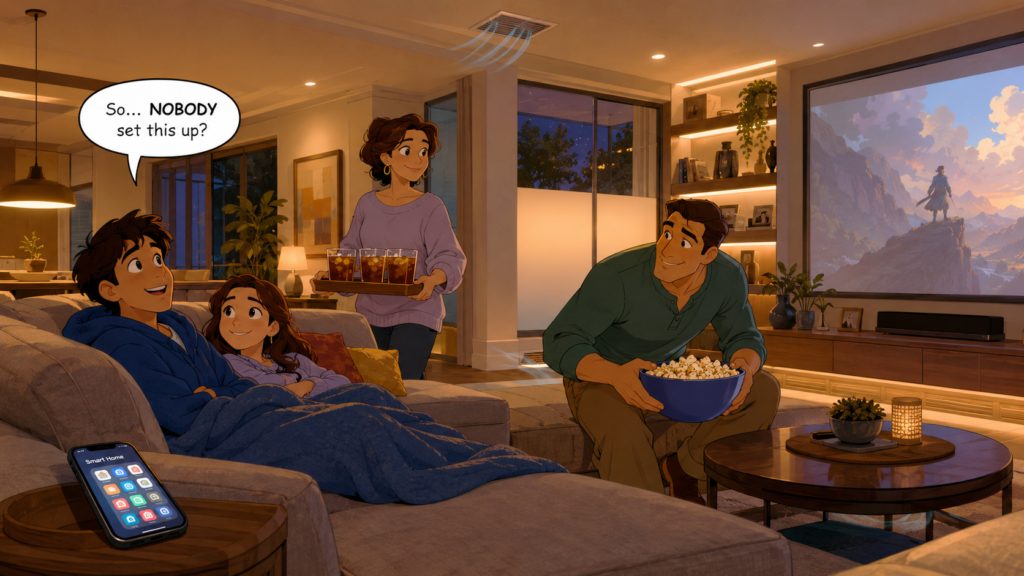
The next smart-home breakthrough may be making the WHOLE house intelligent (and private) instead of adding another device to it.
My house is reasonably smart.
It also has no frigging clue what’s going on.
Lights live in one system. Cameras in another. Speakers somewhere else. Thermostats, locks and assorted sensors each stick to their micro-piece of our world.
Not one of them understands how my family really lives in the house.
That’s why this new idea from LiveLarge Home is so different.
Founder Endong Zhang thinks the industry may be chasing the wrong vision by trying to put a humanoid robot in every home.
His alternative is more interesting:
Make the house itself the robot.
LiveLarge’s new L-Space coordinates lighting, sound, air circulation, privacy glass, projection and an AI assistant called Lila as one environment.
Instead of asking users to manage devices, the system is designed to understand what’s happening in the room and respond accordingly.
The first modes came directly from users: Focus, Reset and Passion.
That framing is worth thinking about.
People rarely wake up wanting to “activate three IoT endpoints.”
They want to concentrate.
Relax, maybe watch a movie.
Spend a little quality time together.
LiveLarge is essentially trying to move the smart home from device control to situational understanding.
And there’s one design decision that makes the most sense to me:
Most of the intelligence happens inside the house.
The system uses an NVIDIA Jetson Orin for local AI processing, allowing conversations, biometric information, visual data and usage histories to remain on-device rather than constantly travelling to the cloud.
Individual family members get separate profiles, and the system is being designed around different permission levels for residents, guests and service providers.
That’s essential.
An AI that understands your home needs to know an extraordinary amount about you.
Like who’s home.
What room they’re in right now.
What (more or less) they’re doing.
What routines they follow.
And what they each prefer.
That degree of personalization becomes creepy FAST if the house is constantly sending all the info somewhere else.
Process it all locally, though, and the proposition changes.
One of the ideas I explore in I Need That is that innovation becomes compelling when technology disappears behind a better outcome.
I think smart homes have spent too long selling us smarter one-off automated things.
The more desirable opportunity may be a home that understands those things collectively, then gets the heck outta the way.
LiveLarge even imagines your household model moving with you when you change homes. So the building gets handed off to someone new, but your preferences, history and learned routines follow you.
That begins to sound less like home automation, and more like an operating system for where you live.
That excites me more than a humanoid ‘bot zipping around the kitchen.
If you’d like help creating and marketing products people feel compelled to buy, the product marketing consultants at Graphos Product can help.