
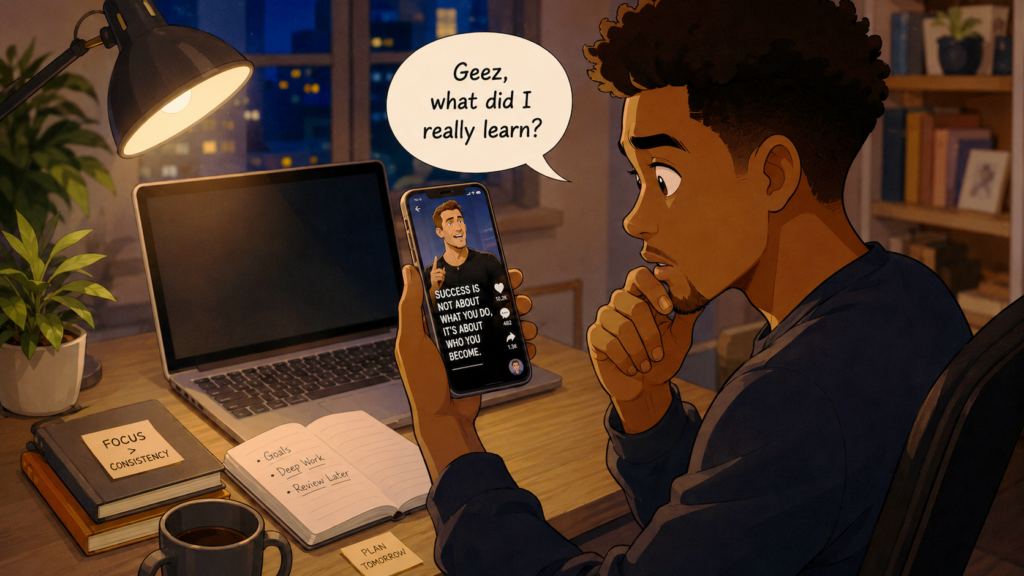
We all tell ourselves we’re learning from those endless business clips. New research suggests endless, rapid-fire series of shorts can do our brain more harm than good.
It feels like more and more often I fall into the short-video rabbit hole.
One minute I’m watching a 30-second lesson from Simon Sinek. Then Tony Robbins. Followed by some startup founder explaining how scaling really works. And then maybe a venture capitalist sharing negotiation tips.
Before I know it, twenty minutes have disappeared.
Like many people, I reassure myself that it’s productive because I’m learning lots of stuff.
But guess what? A brand new study throws ice all over that assumption.
Researchers compared people who accessed the same material through social media-style short videos versus longer, continuous videos. Across three experiments, the short-video viewers remembered less immediately and, when they were intentionally trying to learn, forgot significantly more by the next day.
Brain imaging also showed weaker neural synchronization in regions associated with sustained attention, memory, and cognitive control.
In short, look like I really am wasting my time on most of those tempting shorts.
That doesn’t mean short videos are useless.
They are magnificent at capturing attention. They make discovery effortless and clearly enjoyable. And they have an ability to spark curiosity better than just about any format we’ve ever invented.
The problem comes when we mistake exposure for learning.
Recognizing and observing an idea isn’t exactly the same as retaining it in our memory. And feeling inspired is clearly different from building expertise.
There’s also an important product lesson tucked in here.
Platforms like TikTok, Instagram Reels, YouTube Shorts, and even LinkedIn have become super good at optimizing for attention because that is their money-making superpower. The algorithm’s job is to keep us watching so we can see lots of ads.
So, it’s actually a gigantic product success. (Just not necessarily so for the person watching.)
In I Need That, I explain that truly successful products fit the way people naturally think and behave.
While today’s media environment rewards speed and novelty, honest-to-goodness learning depends on reflection, context, and emotional connection.
Ideas need to set in before new ones hammer you.
For sure, the best way to earn attention sometimes can be with a short video. But the best way to create lasting value includes helping people slow the heck down.
Want to make your product irresistible? That’s what we do as product marketing consultants at Graphos Product, helping innovators turn need-driven ideas into market-ready successes.