
Many of us claim to be practical shoppers. Then we happily pay thousands more for something nobody has ever touched.
Confession time.
I talk a lot about being pragmatic, but I love buying new.
There’s something about being the first person to open the box. I delight in peeling the protective film off the screen. I like knowing exactly where the product has been for its entire life.
And judging by a pertinent new study, I’m far from alone here.
Researchers have identified what they call “new product bias”: an implicit preference for new products over used ones, even when the used version offers exactly the same functionality at a way lower price.
Maybe that sounds dumb, until you start looking at your own buying decisions.
Like cars.
The moment a new one drives off the lot, a huge chunk of its value goes *poof!* The used version parked right beside it may deliver almost exactly the same ownership experience for way less money.
Yet millions and millions of people continue shelling out for new.
The researchers argue that much of this behavior isn’t entirely rational. Instead, many consumers automatically associate “new” with “better” through a collection of mental shortcuts that operate below conscious awareness.
What I found especially interesting is how they broke this bias into three dimensions.
First comes valuation. We tend to assume new products are worth more.
Then gratification. There is genuine pleasure in being the first owner.
And finally, social acceptance. New products often carry subtle signals about status, success, and how we want others to see us.
Honestly, I can relate to all three.
That said, I’m far from opposed to buying used.
My kids are capable of outgrowing skates at about two sizes a season. Buying used makes perfect sense there. I’ll happily buy a used tool when I don’t need the latest model, and I regularly sell products we no longer use. (In our house, that’s my job.)
In fact, I definitely spend more time preparing products for their next owner than normal people do. I clean them thoroughly, photograph them carefully, and whenever possible include the original packaging. If I’m selling an old phone, that box comes out of storage looking like the day I first saw it.
The reason is pretty simple.
I know the next owner wants a little taste of new too.
That’s the thing.
The bias doesn’t disappear when a product becomes second-hand. Many of the strongest resale brands work hard to recreate the emotional experience of buying new.
Refurbished products arrive spotless. Packaging is carefully designed, and warranties reduce uncertainty. So, the goal isn’t simply to sell a used product, but to preserve some of the feelings associated with newness.
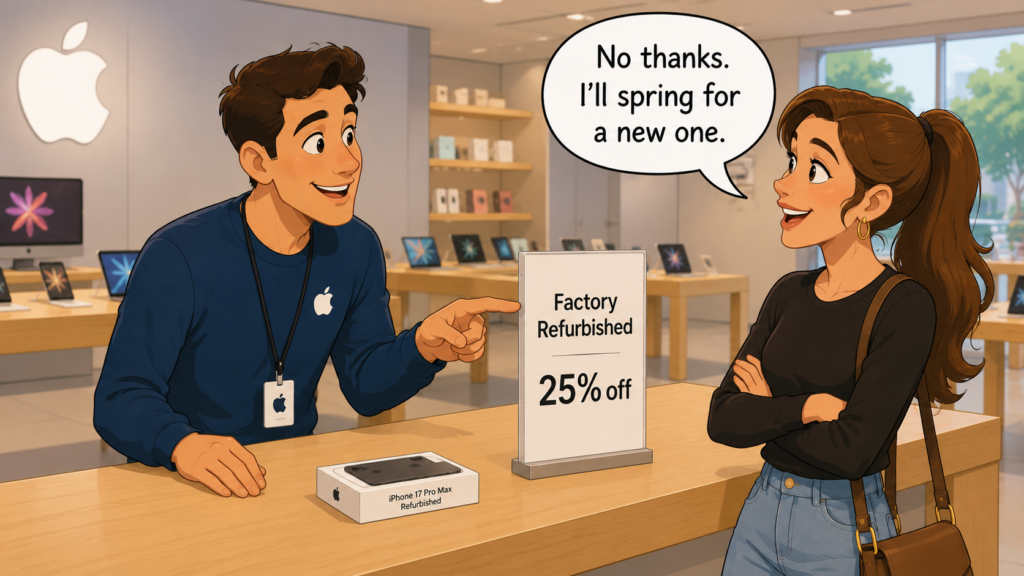
You can see this in programs from Apple, Canada Goose, REI, and many others that have embraced refurbishment and resale. The products may have enjoyed a previous life, but the buying experience still aims to feel reassuring, premium, and new-to-someone-else.
In I Need That, I talk about how products succeed when they satisfy emotional needs alongside practical ones. New product bias is a perfect example. Consumers are seldom purchasing functionality.
They’re usually seeking certainty, ownership, and sometimes a story they own all to themselves.
And sometimes they’re buying the delight of being the first person to unseal that box.
Want to make your product irresistible? That’s what we do as a product marketing agency at Graphos Product, helping innovators turn need-driven ideas into market-ready successes.