
Lots of companies try to use anchoring. Very few execute it to perfection.
In 1974, psychologists Daniel Kahneman and Amos Tversky published one of the most famous studies ever in behavioral economics.
Participants watched a wheel spin to a random number, either 10 or 65, then estimated the percentage of African nations that were in the UN.
The random number they saw HEAVILY influenced their answers.
People exposed to the number 10 guessed an average of 25%.
The ones exposed to a 65 guessed an average of 45%.
A random, meaningless number shifted perception by a full 20 percentage points.
That’s anchoring.
And few product launches demonstrated it more perfectly than the original iPad unveiling.
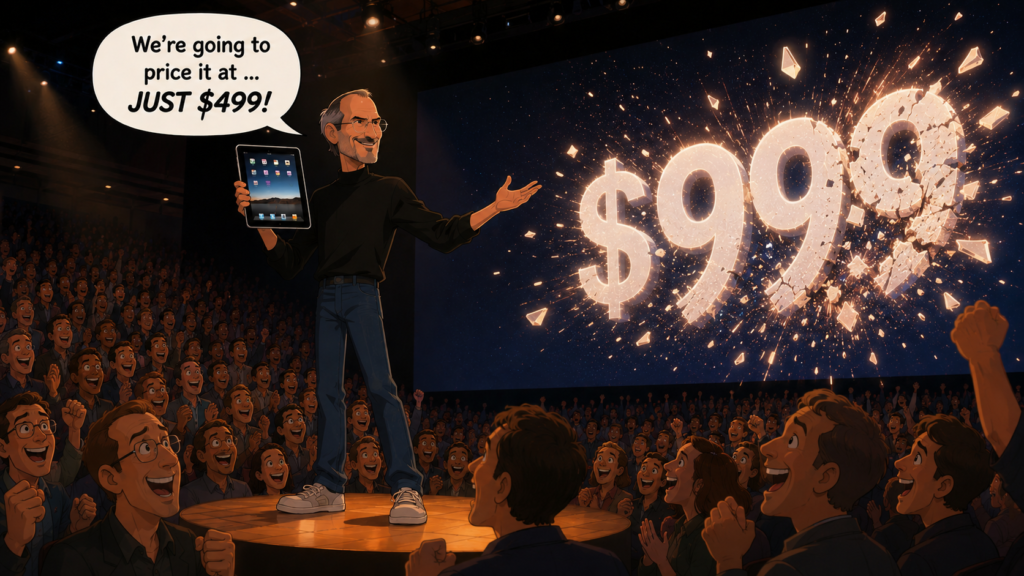
When introducing the product in 2010, Steve Jobs addressed rumors that Apple would price the iPad under $1000.
A giant “$999” appeared on the screen behind him while he calmly explained the product’s capabilities and value.
He let that number stay up there.
For nearly a full minute.
That bit matters WAY more than most people realize. The audience had enough time to emotionally process the price, rationalize it, and begin accepting it as a thing.
Only then did Apple smash the number away and reveal the actual price: $499.
The audience erupted.
Today, anchoring is everywhere.
SaaS companies routinely introduce bloated enterprise tiers to make mid-tier subscriptions feel affordable.
Automakers launch premium trims first to soften reactions to later pricing.
Even restaurants use absurdly expensive menu items to reposition what “normal” ones feel like.
Some companies have tried to imitate the Apple playbook directly.
The Cybertruck launch carried shades of it, with ultra-expensive early Foundation Series pricing helping later versions appear more attainable.
But the effect worked differently because the broader product reception became deeply polarized.
The launch generated enormous visibility, but also years of ridicule, cancellations, and backlash that complicated the anchor itself.
That’s the difference between using anchoring in basic principle and mastering it strategically.
Jobs didn’t just mention a high number in passing or put it up as a fake option.
He controlled the emotional sequence around it. The pacing, the tension, the relief. And especially the story.
The audience walked away feeling like Apple had given them something generous, even though $499 was still premium pricing for a personal device in 2010.
That’s what great anchoring does.
It doesn’t merely change what people pay.
It blows what feels reasonable all to hell.
What products have you seen use anchoring especially well lately?
Want to make your product irresistible? That’s what we do as product marketing consultants at Graphos Product, helping innovators turn need-driven ideas into market-ready successes.