
We use the word “need” so casually that we forget how radical its evolution has been.
A few days ago I wrote about how most needs aren’t needs at all.
They’re stories our minds learned to believe.
And the deeper I have looked, the more striking the shift became.
In I Need That, I cite a linguistic analysis of one million English-language books:
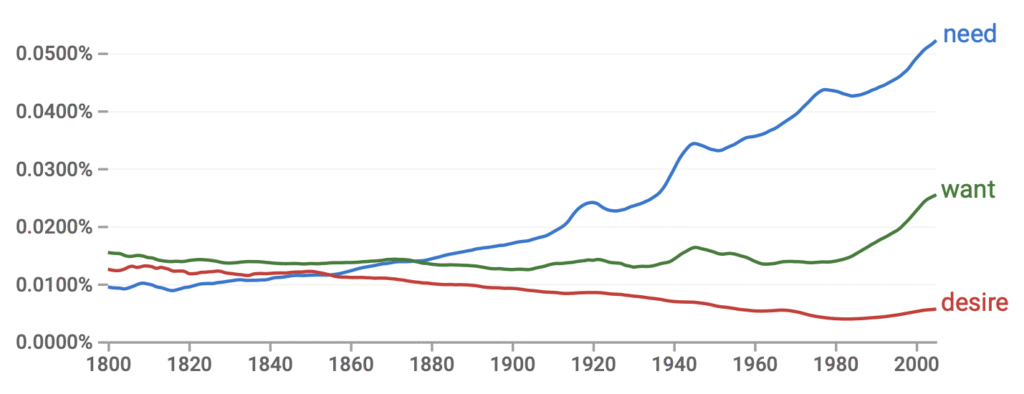
Two centuries ago, “need” appeared once every ~10,000 words.
Today it appears once every 2,500.
If you include “needs,” it jumps to once every 1,600 words … a six-fold rise since 1800.
Meanwhile, “want” stayed mostly flat.
“Desire” declined.
But “need”? It blew the hell up
The spikes even match historical stress points: World Wars I and II, the 1973 oil crisis, recessions.
When times get tough, our language shifts from “would like” to “must have.”
So what happened here?
Did we genuinely come to need more things?
Nope. More like the opposite.
Wealth rose.
Survival vastly improved.
The true foundational needs (food, water, shelter) became way easier to secure for more people.
But instead of relaxing and enjoying, we recalibrated all expectations.
We expanded our definition of “need” to cover convenience, comfort, efficiency, status, speed, and identity.
THAT is the landscape modern product makers operate in.
You’re not building for survival needs here.
You ARE building for perceived needs: psychological, social, emotional, aspirational.
Your product succeeds when you understand the customer’s evolving baseline for what will feel essential in 2026 … not what was essential in 1800.
“Need” is always a moving target.
Your job is knowing where it’s moving TO.
Want to make your product irresistible? That’s what we do as product marketing consultants at Graphos Product, helping innovators turn need-driven ideas into market-ready successes.