
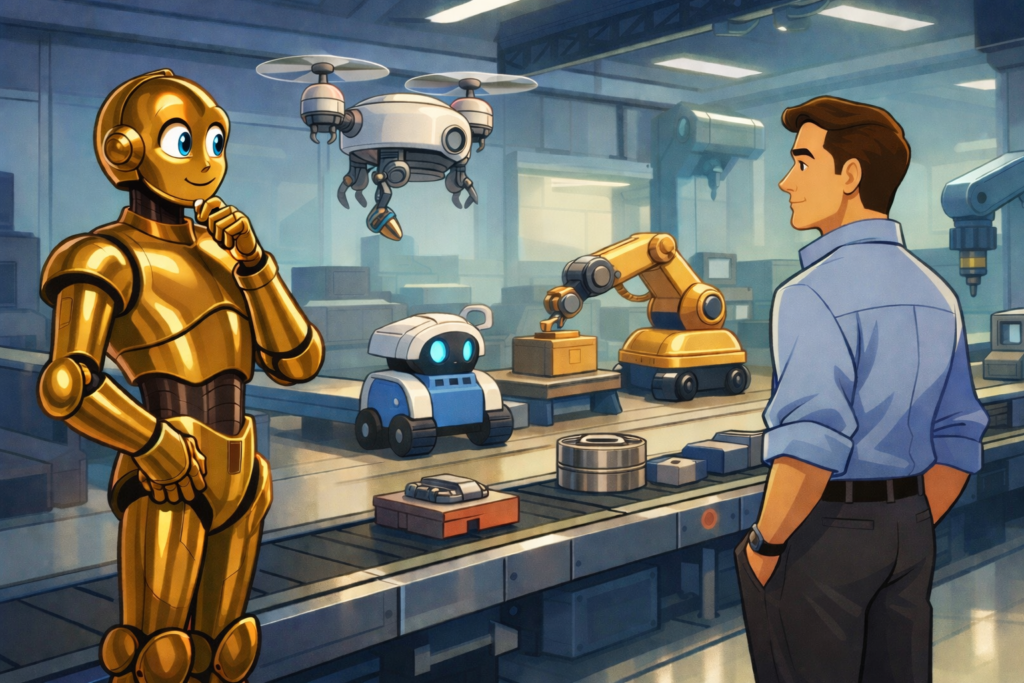
What we imagined robots would be doing by now, and why they aren’t.
If you grew up watching sci-fi like I did, you probably expected humanoid robots to be everywhere by 2026.
Walking factory floors. Filling labor gaps. Doing the dull, physical work we would rather avoid.
Instead, Gartner predicts that by 2028 fewer than 100 companies will move humanoid robots beyond pilot programs, and fewer than 20 will deploy them at full operational scale in supply chains or manufacturing.
I believe that gap between imagination and reality is instructive.
Humanoid robots feel intuitive (and inevitable) because they match us, right?
Same limbs, same spacial relationships. Same form factor for tools. The promise is seductive: just drop ’em into the world we already built.
But most operations are NOT constrained by the human shape. They are constrained by stuff like variability, uptime, energy use, integration complexity, and the cost of failure.
So mimicking the human body turns out to be an expensive way to solve problems that do not actually require it.
I expect specialized, non-humanoid robots to keep winning gradual battles. Machines built for sorting, lifting, assembling, or moving, unconcerned with looking familiar, and very concerned with doing ONE thing super reliably.
Gartner’s view is really about respecting physics, economics, and maturity curves.
This kind of thing shows up in product work everywhere.
The form people expect is often not the one that ends up scaling first. The products that do win early are the ones that accept the world as it is (as a prominent politician recently quipped), instead of insisting it bend to our idealized shape.
C-3PO will arrive eventually.
I just would not bet your operations on him showing up next year.
Want to make your product irresistible? That’s what we do as product marketing consultants at Graphos Product, helping innovators turn need-driven ideas into market-ready successes.