
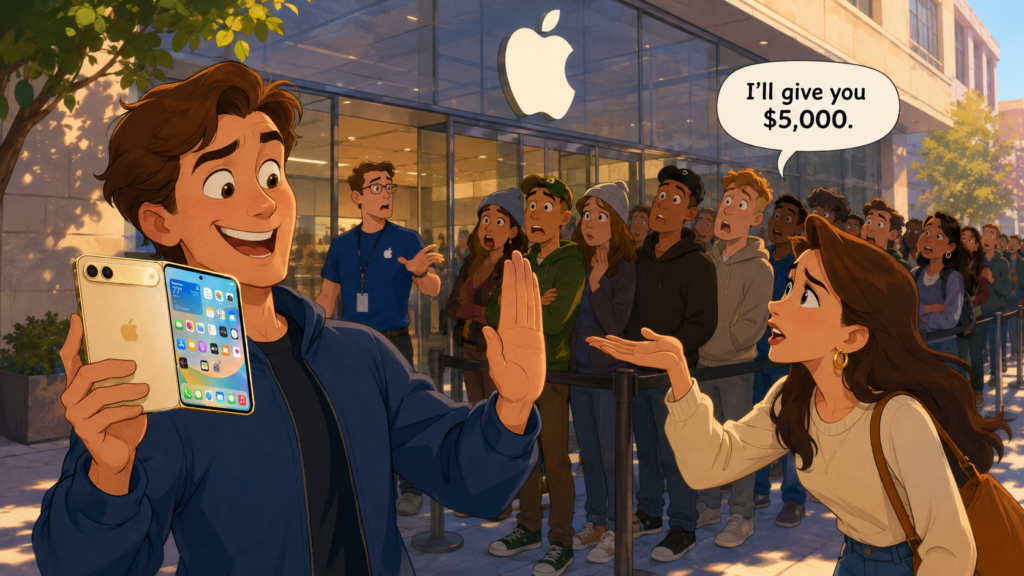
Apple may be late to foldable phones, but watch its arrival reset what consumers expect to pay for one.
Samsung launched its first Galaxy Fold in 2019.
Apple sat back and watched.
Other manufacturers joined in. Hinges sucked, but improved. Screens became tougher. Devices got thinner. That ugly crease down the middle became… less ugly.
And Apple kept on watching.
Now, seven years later, we’re apparently weeks away from seeing Apple’s answer.
Multiple current reports point to Apple unveiling its first foldable iPhone alongside the iPhone 18 Pro models in September.
The name hasn’t been confirmed, although iPhone Ultra is increasingly being suggested.
And this thing sounds pretty cool.
Folded, it’s expected to have a relatively compact 5.5-inch outer display.
Open it like a book and you get roughly 7.8 inches of screen, approaching iPad mini territory.
Early testers reportedly love the iPad-like layouts on that larger display, along with the hinge and surprisingly pocketable form.
Apple has also spent huge bucks solving one of the things that has always been a deal-breaker for folding phones: that damned crease.
Reports suggest the company waited until its display tech could produce an inner screen with a virtually invisible crease, while continuing to obsess over hinge durability.
How very Apple.
The company has rarely needed to be first into a category.
It entered MP3 players YEARS after they appeared. Smartphones existed before the iPhone, and tablets existed before the iPad.
Apple waits patiently until it understands how to make the experience substantially better, then enters with enough scale and cultural gravity to blow up expectations for everybody else.
Including expectations about price.
Current estimates put the foldable iPhone around US$2,300 to $2,500, with higher-storage configurations potentially approaching $3,000.
Experts expect Apple’s entry to help push the average selling price of foldable smartphones up 18% this year.
That’s an extraordinary pile of cash for a phone.
It’s also the wrong way to frame the product.
Whip this thing open, and you’re basically carrying an iPad in your pocket.
For someone who travels constantly, works from a phone, reviews documents, watches video or regularly wishes their screen were bigger, replacing some of the utility of two devices with one starts changing the calculation.
Years ago, when I travelled way more and worked constantly from my phone, I’d already be rationalizing the purchase to myself.
Today, I’d have a harder time. But heaps of Apple fans won’t.
And Apple may semi-inadvertently have created one of the oldest drivers of desirability: scarcity.
Analyst Ming-Chi Kuo expects manufacturing constraints to severely limit early supply. Apple could announce the phone in September but delay preorders until later, as it did with the iPhone X.
Kuo estimates only 7–8 million units will ship this year and predicts the first supply could sell out immediately.
Imagine what that does to a product like this:
Apple’s first-ever folding iPhone.
A radically recognizable, covetable new form factor.
A price that makes ownership exclusive.
And THEN, you can’t get your mitts on one.
For early adopters, that last bit will make the first three even more compelling.
One of the ideas I explore in I Need That is that product desirability extends far beyond utility. Novelty, identity, status, scarcity and anticipation can all become part of the value customers perceive.
Apple may be about to combine all of them in one launch.
The interesting lesson for product creators is that being first and being definitive are very different competitive advantages.
Samsung CREATED the modern foldable category.
Apple is about to show millions of people they finally NEED one.
If you’d like help creating and marketing products people feel compelled to buy, the product marketing consultants at Graphos Product can help.