

Toyota’s Walk Me asks a useful innovation question: what if the limitation you’ve been improving around is the thing that needs replacing?
Wheelchairs have been in slow evolution for a super long time.
The earliest known depiction of one dates to about 525 AD, and Spain’s King Philip II had a wheeled chair built for him in 1595.
The first recognizably modern folding wheelchair arrived in the 1930s.
They’ve gotten lighter, faster, more comfortable and way more sophisticated.
Yet their defining technology remains that greatest of all innovations, the wheel.
And a six-inch curb still becomes a wall that might as well be a mile high.
Toyota’s Walk Me concept attacks that limitation at its source.
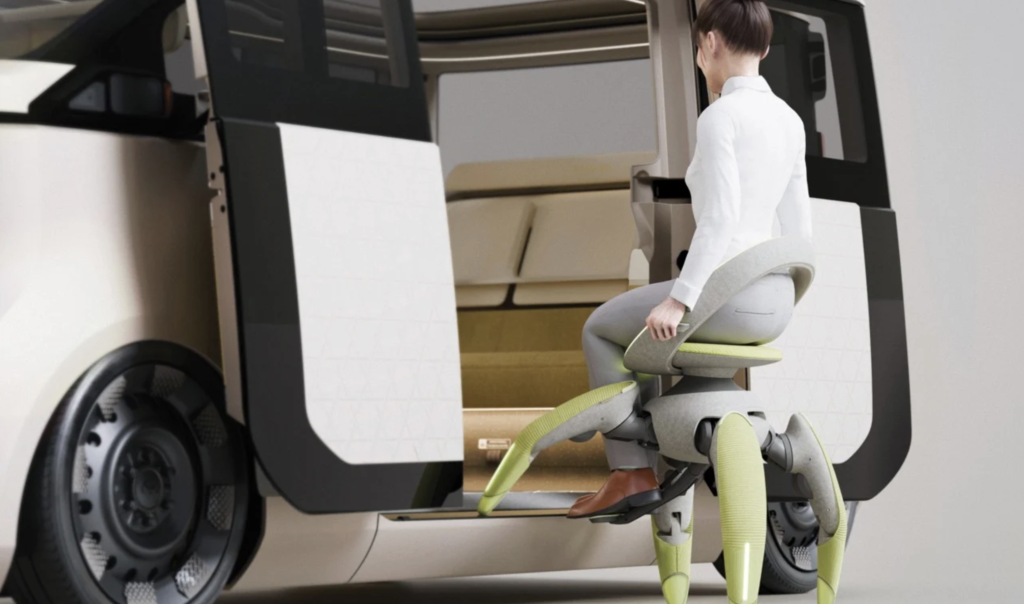
Image: Toyota Motor Corporation
It replaces wheels with four robotic legs that can climb stairs, negotiate curbs, move sideways through tight spaces, crouch for easier boarding and raise the rider to eye level with someone standing.
The design recently won the 2026 Red Dot: Luminary, the competition’s highest concept-design honour.
Looking at it, I can’t help thinking you’re riding Rocky from Project Hail Mary.
Which, frankly, makes it even better.
The important innovation here is conceptual. Product teams often spend decades improving an established architecture because its underlying assumptions have become invisible.
Stuff like better tires, suspension and motors.
Toyota asked why a mobility chair needs wheels at all anymore.
That opens up so much more than stairs.
Walk Me can elevate its rider for conversation rather than requiring them to spend their day looking upward.
Its knitted coverings and furniture-like body also move the product away from clinical equipment toward something deliberately welcoming.
It’s still a concept, with no price or production date. And carrying a human safely on robotic legs presents enormous engineering, reliability and cost challenges.
But this is exactly what ambitious product development should occasionally do:
Stop tweaking the workaround and solve the damned constraint.
If you’d like help creating and marketing products people feel compelled to buy, the product marketing consultants at Graphos Product can help.