
If you’re going to make a claim, please be sure it means something.
A visit to the toothpaste aisle delivers a boatload of confident claims.
“Strengthens enamel.”
“24-hour cavity protection.”
“Designed with dentists.”
“Sugar free.”
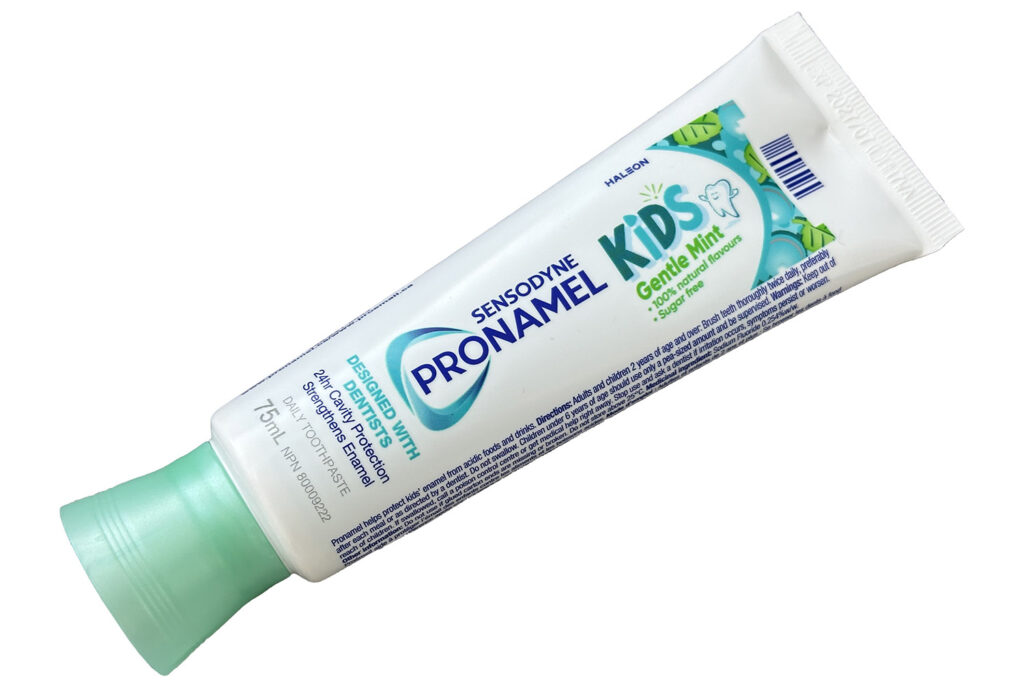
Recently we bought several tubes of Sensodyne Pronamel Kids toothpaste at Costco for our girls.
Sensodyne makes solid products and has a legitimate position around sensitivity and enamel protection. That’s a real functional benefit where the brand grew by standing way out.
But THIS packaging reminded me how peculiar toothpaste marketing has always been.
It had all the above claims, and one had me shaking my head.
Sugar free.
I looked it up, because the label made me wonder if some toothpaste somewhere contains sugar.
Of course none does!
Putting sugar in toothpaste would be like selling sunscreen with added UV.
Yet there it is on the tube as a top benefit, like the product has heroically eliminated something other brands are recklessly including.
That’s not the only claim doing rhetorical gymnastics.
“Designed with dentists.”
My grandpa was a dentist. He rocked at diagnosing cavities, repairing teeth, and calming terrified children. (I still use a relaxation technique he taught me in his dentist’s chair.)
But designing toothpaste formulas was nowhere near his lane. That work belongs to chemists, formulators, and materials scientists.
“24-hour cavity protection” raises a similar eyebrow.
Unless the toothpaste follows your kids around all day, it’s hard to imagine how that promise survives the next snack, juice box, or candy bar.
Then there’s the familiar line: “strengthens enamel.”
I’m sure there is scientific backing here. Toothpastes are regulated products, and companies cannot invent claims out of thin air. Fluoride is well known to help remineralize enamel under certain conditions. Is that old table stake the one we’re going on about?
But the phrase still floats somewhere between science and marketing shorthand, leaving most consumers to interpret it however the heck they choose.
The toothpaste aisle has a long history of this kind of differentiation theater.
Decades ago, brands struggled to stand apart because most formulas were chemically very similar. Crest famously trademarked Fluoristan®, even though the active ingredient was the same sodium fluoride used by most competitors. The trademark created the illusion of a unique breakthrough while relying on the same core chemistry.
But it worked. It gave consumers something memorable in a category where the underlying differences were small.
Which brings us back to the modern toothpaste shelf.
Many of the claims today function less as meaningful product distinctions and more as signals of safety.
They reassure parents and shoppers that THIS product belongs in the responsible, health-minded part of the category.
The toothpaste surely works fine. I have zero doubt or worry that it does.
But the language reveals something I dislike about crowded product categories.
When functional differences shrink, marketing fills the gap with meaningless noise rather than substance.
My message for product makers and marketers is to please never mimic this behavior.
If your category is saturated with nearly identical products, the temptation to invent hollow differentiation becomes strong.
But the brands that truly stand out peg themselves to a real, meaningful advantage.
Want to make your product irresistible? That’s what we do as agency for marketing physical products at Graphos Product, helping innovators turn need-driven ideas into market-ready successes.