
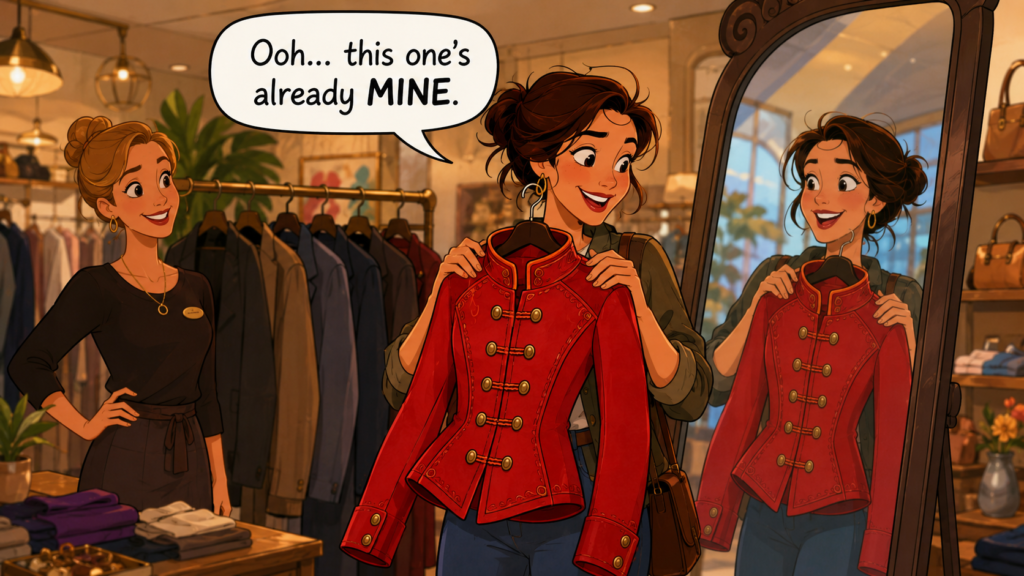
The right words can make customers start thinking, “That’s mine.”
Most product descriptions follow a familiar formula.
They explain WHAT a product does.
Then list the key benefits.
Maybe toss in a few overused adjectives like “premium,” “innovative,” or “high-performance.”
New research shows they could be skipping something way more powerful.
Researchers found that concrete product descriptions triggered stronger feelings of psychological ownership than abstract ones.
A “red shirt with glittery buttons” produced a more powerful sense of ownership than an “excellent party shirt.” That subtle shift also juiced up what people were willing to pay.
It makes sense when you think about it.
Nobody owns the vague idea of a running shoe.
They own THAT running shoe. The one with the bright orange laces, the slightly oversized heel, and the funky groove down the sole.
I devoted an entire section of I Need That to the psychology of psychological ownership because it shows up everywhere … from product descriptions and packaging to demonstrations and retail experiences.
The more ownership a customer feels before purchase, the easier the purchase itself becomes.
The more your product becomes a unique, tangible object instead of another member of a category, the easier it becomes for customers to picture it as theirs.
Features still help.
And benefits, even more.
But the research shows that ownership sets in when a product gets ultra-specific.
If you’d like help creating and marketing products people feel compelled to buy, the product marketing consultants at Graphos Product can help.