
One of the greatest ads in history succeeded by calling out the status quo.
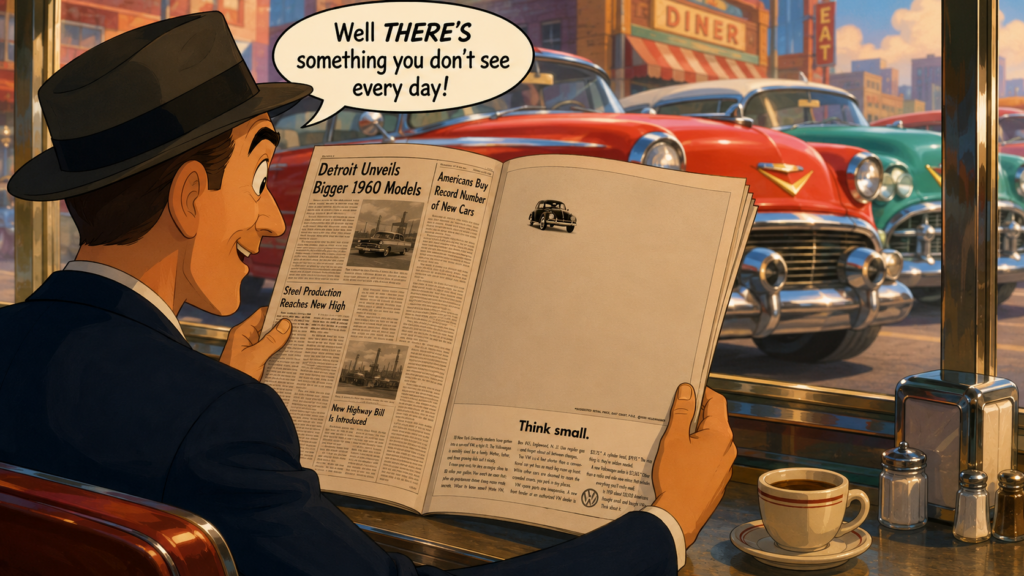
In 1959, Volkswagen ran what would become one of the most celebrated advertisements ever created.
You’ve probably seen it.
A tiny image of a Volkswagen Beetle sits alone on a vast field of empty space above a simple headline:
Think small.
The ad has been analyzed for decades. It’s often credited to legendary copywriter Julian Koenig at Doyle Dane Bernbach, one of the most influential agencies in advertising history.
Some say it was inspired by IBM’s famous THINK sign. Others believe it later influenced Apple’s Think Different campaign.
Sure, maybe.
But I’ve always felt people focus on the wrong word.
The magic wasn’t “think.”
It was “small.”
More specifically, it was the surprise of saying that.
In 1959, Americans were living through the golden age of excess on wheels. Cars grew longer, wider, heavier, and flashier every year. Tailfins got taller. Chrome multiplied.
Bigger represented progress, kids.
Then Volkswagen showed up and proudly advertised the exact opposite.
The company didn’t try to disguise the Beetle’s size. It didn’t apologize for it. It made smallness the entire point.
Even the ad itself behaved differently.
You didn’t expect a full-page newspaper or magazine ad to leave most of the page empty. You didn’t expect the product photo to be minuscule. And you certainly didn’t expect a car company to promote a characteristic that every competitor seemed hell-bent against.
The ad challenged expectations before the copywriter ever had a chance to make an argument.
That’s what forced folks to stop.
And once they stopped, they had to, had to, HAD TO read the copy.
Fortunately, the copy was fantastic.
Howard Gossage wrote 65 years ago: “Nobody reads ads. People read what interests them, and sometimes it’s an ad.”
That’s an important lesson because marketers often study famous campaigns by copying the visible elements: the headline, typography, layout and color palette.
The real win is usually not there.
The audience has to notice you before they can agree with you. And you can’t get noticed by being similar to what people see all the time.
That’s still the game today.
A few days ago, Heinz and Heineken generated attention by putting a bottle of ketchup inside a six-pack of beer. Nobody on earth was asking for ketchup-packaged-with-lager. The stunt worked because it created the same kind of interruption in the mind.
Wait.
What’s THAT doing there?
In I Need That, I talk about how compelling products often succeed by challenging assumptions people didn’t even realize they were carrying.
The most powerful ideas make people look again.
And once they do, you’ve earned the time to tell your story.
Want to make your product irresistible? That’s what we do as product marketing consultants at Graphos Product, helping innovators turn need-driven ideas into market-ready successes.