
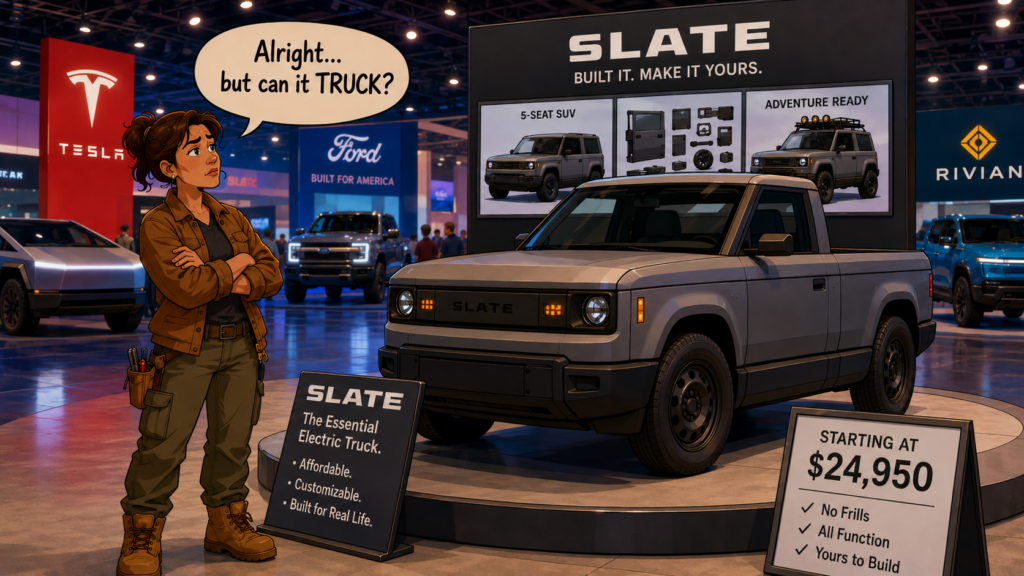
Slate’s radically stripped-down EV truck is one of the most interesting vehicle launches in years, because it challenges every assumption about what North American truck buyers supposedly want.
I guess I’m a bit of a truck guy.
I like trucks for practical reasons. I want to haul my family, haul gear, haul lumber, and whatever suburban life lobs at me, without overthinking it.
And trucks are awesome because they make tasks easier in so many ways. But damn, they’re expensive.
That’s why the new Slate EV Truck has people’s attention.
It’s being called “the most affordable truck in America,” starting at US $24,950 when it comes out later this year. That headline alone is enough to turn heads in a market where the average new vehicle runs you well over $45K.
Then you look closer.
This thing is weird, dude.
But mostly in a good way.
The base model is a two-door, two-seat, fully electric pickup with hand-crank windows, no stereo, no touchscreen, plain-jane steel wheels, and a 205-mile (330 km) range. Slate calls this the “Blank Slate,” a name that tells you pretty much everything about the strategy.
You start with close to nothing.
Then you add on all the stuff you want. Whenever you’re ready.
You can add wraps, accessories, racks, audio, suspension upgrades, or even convert it into a five-seat SUV (albeit still with two doors). Slate is starting out with more than 200 accessories and leaning hard into direct-to-consumer, DIY customization.
in fact, they’re even making it easy to 3-D print your own accessories and components that fit perfectly.
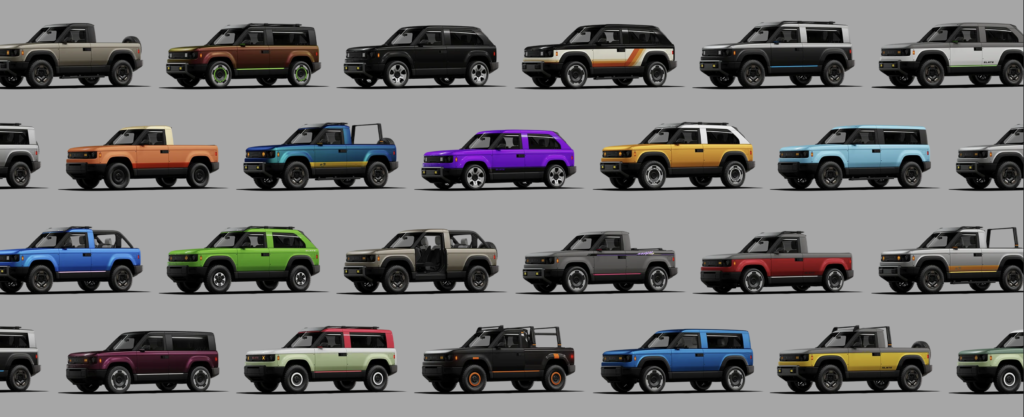
Image: Slate Auto
From a product strategy perspective, I find all this super fascinating.
Other automakers bundle features into trims and packages. Slate is doing the exact opposite. They’re unbundling the truck and making customization the product.
That feels refreshing.
It also feels crazy risky.
Because while people say they want affordable vehicles, North American truck buyers have been trained to value some very specific attributes: power, capability, range, durability, and yes, a certain amount of … truckiness.
Slate challenges exactly all of that.
Its towing capacity lands around 1,000–2,000 pounds depending on spec, well below what many truck buyers expect.
That (expected) 205-mile range is modest. Plus the thing is compact, almost tiny by modern truck standards. And while the stripped-down simplicity feels refreshing, I suspect plenty of buyers will view it as a bit TOO stripped down.
That’s where my own hesitation kicks in hard.
By the time I configure a Slate into something genuinely useful for my family, the bargain starts shrinking.
I’d still have a small two-door platform, and the value equation gets murkier than a slough in August.
Still, I respect what Slate is trying to do.
They’re building something genuinely different in a growing sea of sameness.
And that matters.
This is exactly the kind of question I explore in I Need That.
Sometimes the biggest opportunities come out of challenging assumptions everyone else accepts as fixed. But the boldest product bets also carry the greatest risk, especially when customer expectations are firmly, deeply ingrained.
Slate may just have stumbled into a huge underserved market.
OR they may have created a truck a narrow niche of product geeks find exciting more than actual money-paying truck buyers ever will.
We’ll find out soon enough.
What’s your take … would YOU consider a Slate? And if so, what would you turn it into?
Hit reply and tell me please! I’d love to have a picture of what real folks think.
Want to make your product irresistible? That’s what we do as product positioning experts at Graphos Product, helping innovators turn need-driven ideas into market-ready successes.