
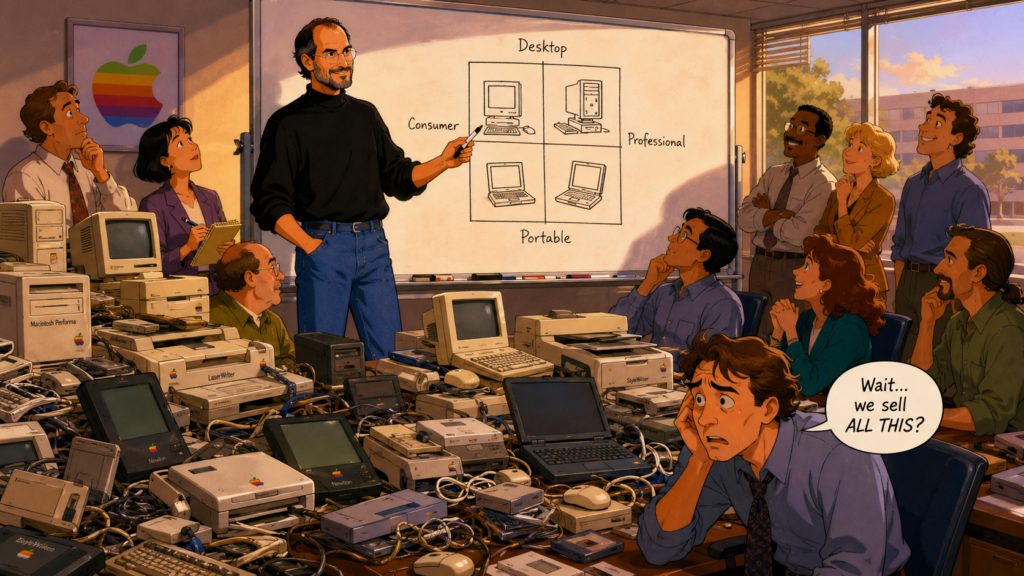
Often the fastest path to growth is removing things.
When Steve Jobs returned to Apple in 1997, the company was in deep, deep trouble.
Apple’s product lineup had become a maze of overlapping computers, peripherals, printers, handheld devices, experiments, and all kinds of half-developed ideas.
Customers were confused. Employees were stretched thin. The company was hemorrhaging money.
At the time, Apple reportedly had around 350 products and product variations in development or on the market.
Within months, Jobs cut that to roughly 10 core products.
Most executives facing that situation would have looked for the next breakthrough product.
Jobs, being Steve Jobs, did the exact opposite.
After reviewing Apple’s offerings at the time, he walked to a whiteboard and drew a simple two-by-two grid: Consumer and Professional on one axis, Desktop and Portable on the other.
Then he announced that Apple would focus on just FOUR core categories. One desktop and one portable computer for consumers. And one desktop and one portable computer for professionals.
Everything else was a distraction, and was gone-zo.
The Newton disappeared. Printers too. Servers, buh-bye. Entire development efforts were slid into the bin almost overnight.
The decision made employees, customers, and investors lose their sh*t.
But Jobs thought different.
Focus is not only deciding what to do, but what deserves the peak excellence you can achieve.
So, Apple’s engineers no longer had to spread themselves across hundreds of competing priorities. Marketing could suddenly tell a clearer story. Manufacturing got way, way simpler. Resources flowed into a handful of products that really and truly mattered.
Within a year came the new, translucent iMac.
A few years later came the iPod.
Then the iPhone.
And then, the iPad.
Looking back, it’s really easy to zone in on those iconic launches. But the more important moment may have been the brutal editing that happened first.
When Jobs came back, he had 90 days of runway before the company would implode. And then, there would have been zero of those breakthrough products.
In I Need That, I write about how compelling products solve meaningful problems with remarkable clarity.
Companies like yours face a similar challenge:
Every new initiative feels promising. Every project has supporters, and every product has a story.
BUT attention is in finite supply.
Talent is finite too.
And so is everyone’s time.
The companies that consistently win are willing to own their “no,” and say it more often than their competitors.
Apple didn’t become the world’s most valuable company by doing more and more.
Want to make your product irresistible? That’s what we do as product marketing consultants at Graphos Product, helping innovators turn need-driven ideas into market-ready successes.