
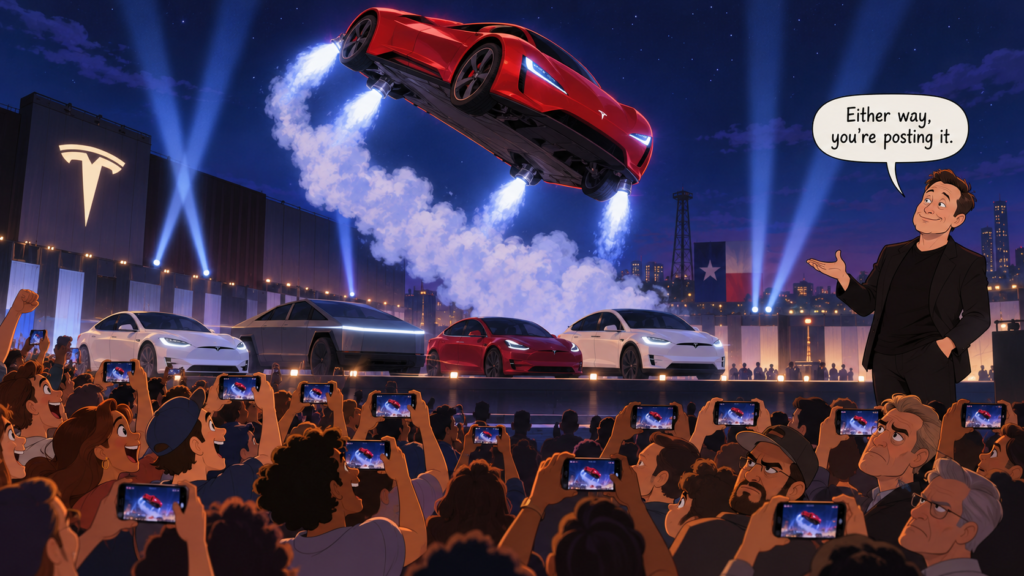
The new Roadster has questionable commercial value, but as an attention-generating product demo it has already worked spectacularly.
Elon Musk unveiled the long-delayed Tesla Roadster this week by having it accelerate to 60 mph in under a second, cling upside down to a ramp and kickflip over Tesla’s existing vehicle lineup using SpaceX-derived cold-gas thrusters.
Then social media did exactly what Musk was countin’ on it to do.
Fans circulated the footage because it looked impossible.
Critics circulated it because they thought it was totally ridiculous.
Fast Company called the Roadster “vaporware,” pointing out that Tesla offered little pricing detail, kick-flipped production to 2028 and now claims roughly 300 miles of range versus the 620 miles promised for the earlier version.
Meanwhile, Top Gear was practically levitating itself, describing the demo as “fiction become fact.”
Same product, but opposite reactions. Mind-blowing distribution, either way.
That’s the clever part.
Musk created an engineering spectacle with remarkably little immediate commercial consequence.
Tesla itself describes the Rocket variant as a one-seat, invitation-only version that isn’t even approved for public-road use.
Reuters characterized the Roadster as a halo car with limited financial significance.
Yet for several days, Tesla has been freakin’ everywhere.
And now here I am, becoming part of it.
The launch gave folks an irresistible object to argue about. Whether or not the Roadster becomes a meaningful product seems secondary to what it has already accomplished as media.
Most launches ask people to understand a proposition.
Musk gave them a car… doin’ a kickflip.
You can call that frivolous, impractical or even a nothingburger.
But good luck scrolling past it.
If you’d like help creating and marketing products people feel compelled to buy, the product marketing consultants at Graphos Product can help.