
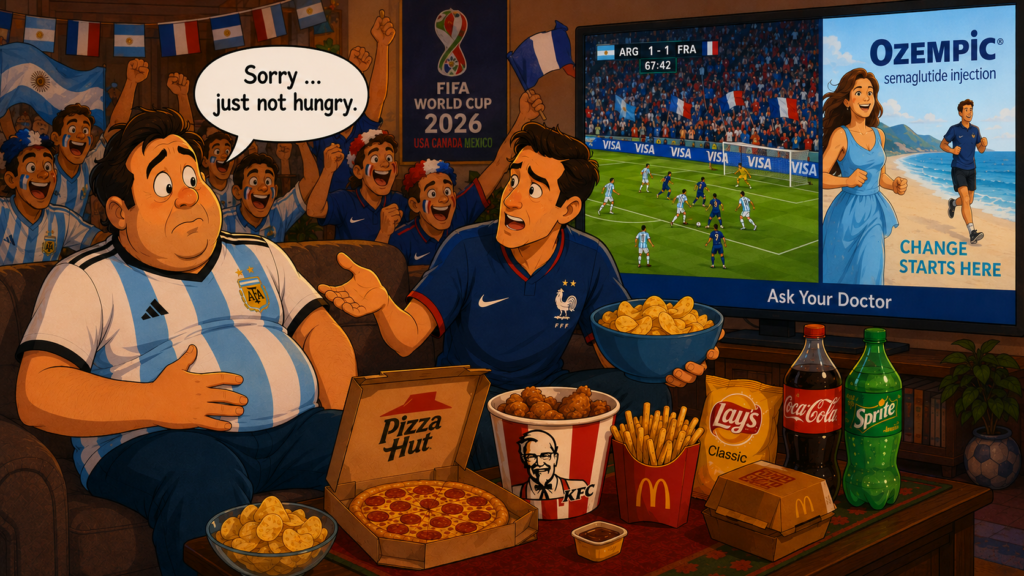
GLP-1 drugs are marketed as healthcare, but their impact is creating a consumer-demand shock across fast food, snacks, alcohol, grocery, apparel … and beyond.
I can barely watch a sporting event, or any TV show, without seeing ads for Ozempic or Wegovy.
That’s having a massive impact, and not just on people’s weight.
Because Ozempic, Wegovy and Mounjaro are healthcare products, for sure.
But they are also powerfully marketed consumer products. Novo Nordisk reportedly spent nearly $500 million in the first nine months of 2025 promoting Wegovy and Ozempic in the U.S. alone.
And their effects go way, way, WAY beyond medicine.
These drugs’ main superpower is suppressing appetite. That means folks taking them eat less, stop snacking and reduce the very behaviours entire industries were built to trigger and cash in on.
That’s a biggie-sized problem for brands whose best customers have historically been the power users now cutting back.
The people ordering Pizza Hut or KFC several times a week. The people grabbing chips, soda and candy on impulse. The ones feeling, as Winnie the Pooh might put it, rumbly in the tumbly.
What happens when millions of those customers stop feeling rumbly?
Morgan Stanley has projected a mind-blowing 24 million U.S. users by 2035, with expected declines in carbonated soft drinks, baked goods and salty snacks as adoption grows.
Some food companies are already responding.
Nestlé launched Vital Pursuit, a frozen food line aimed at GLP-1 users, with high-protein, fibre-rich, portion-aligned meals designed around smaller appetites and reducing muscle loss.
That takes us to another oversized question.
Are these same people eating healthier?
Or are they mainly consuming less of the same old crap?
My guess is both, but unevenly. GLP-1s reduce appetite, but they don’t erase comfort, ritual, reward, convenience OR identity. Old habits lie deep.
Folks may still want pizza, burgers, fries, treats and social meals. They may simply want smaller portions, more protein, lower sugar, less regret and fewer impulse calories.
This is exactly the kind of demand reshaping I explore in I Need That. When a product changes how people feel, behave and make tradeoffs, it can disrupt categories that seem completely unrelated.
Ozempic may be marketed as healthcare.
But its second-order effects look a lot like a new operating system for appetite.
Have you had experience with GLP-1s? How did it affect what you chose?
Want to make your product irresistible? That’s what we do as go-to-market consultants at Graphos Product, helping innovators turn need-driven ideas into market-ready successes.