
The fastest way into a market is to redesign the habit around the product. (If you’ve got the wallet.)
Coca-Cola just launched “Coke Sticks” in Southeast Asia: food-grade stainless steel chopsticks shaped like the contour of a Coke bottle.
The stated challenge behind the idea was revealing:
“With Western food, Coke is the default choice. But with Asian food, Coke isn’t always the first drink that comes to mind.”
That’s a fascinating admission from one of the world’s most dominant brands.
Because it recognizes something many product makers miss: being famous does NOT guarantee relevance in every usage occasion.
So instead of pushing harder with ads, Coca-Cola tried to insert itself into the ritual itself.
Not so much the beverage.
Or the flavour.
But the dining BEHAVIOUR.
The chopsticks become a physical cue sitting beside the plate before any drinks get ordered. A brand reminder, masquerading as a utensil.
Only a company the size of Coca-Cola could consider doing something like this at scale. These things ain’t cheap plastic giveaways. They were engineered as real functional objects and made from pricey stainless steel, then distributed into restaurants and food delivery experiences all across Southeast Asia.
As a branding exercise, it’s remarkably ambitious.
It also made me wonder how the people who actually use chopsticks every day might react.
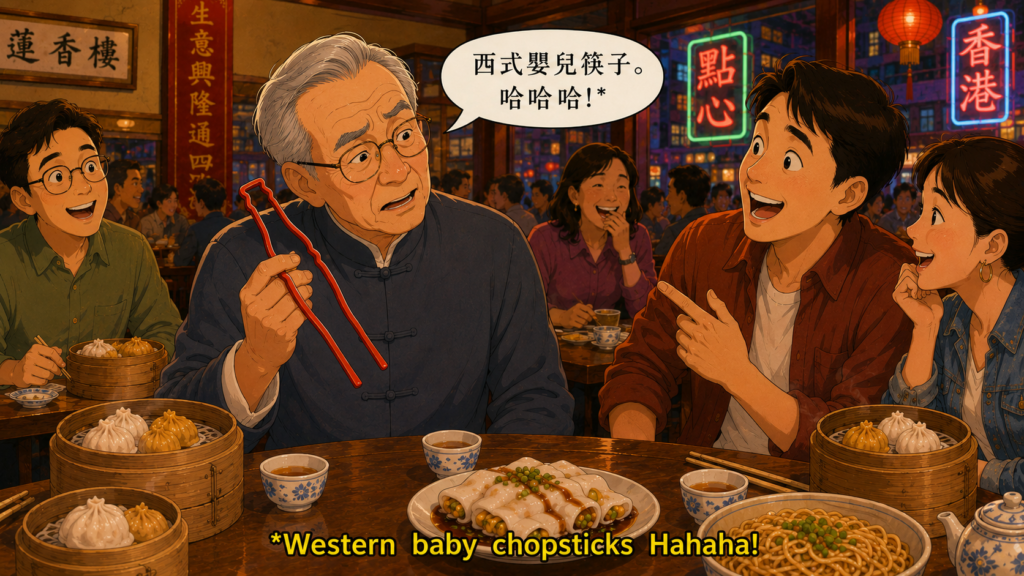
Looking at the design, I immediately thought of the “training chopsticks” often made for children learning how to use them.
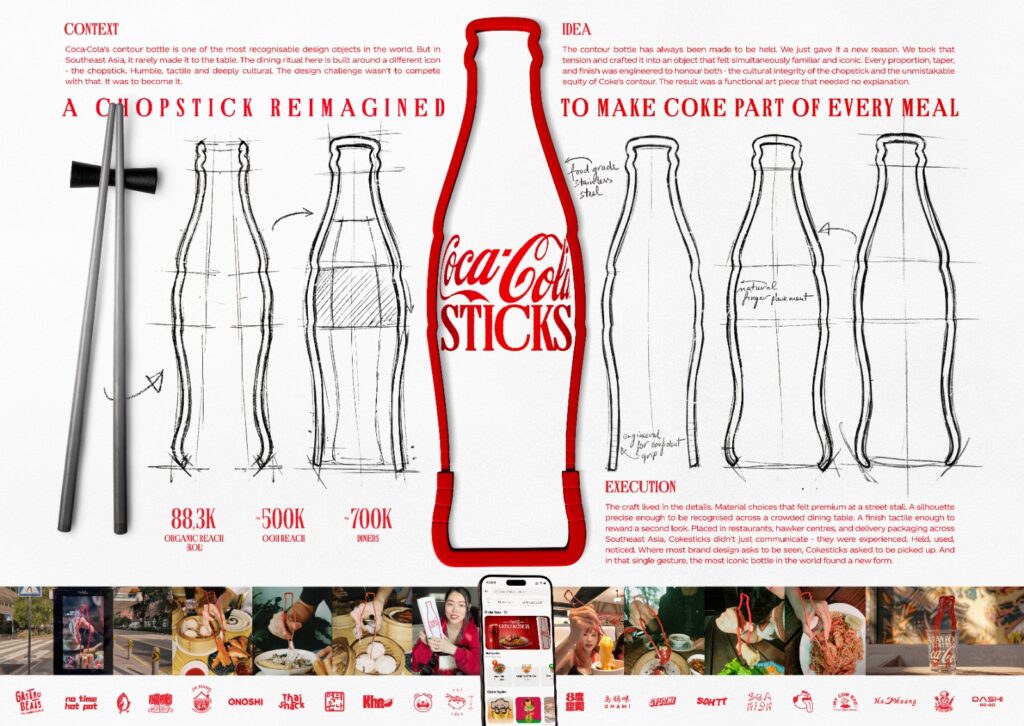
Image: The Coca-Cola Company
Maybe a Western marketer will see clever brand integration. But I suspect a person who has used chopsticks naturally their entire life might see a US-based global brand redesigning someone else’s object that has been perfect for centuries.
That tension might be what makes the campaign so intriguing to me.
Global brands often want to participate in cultural rituals because rituals create repetition, familiarity, and emotional attachment.
BUT the closer a brand gets to those rituals, the easier it becomes to mistake familiarity for ownership.
I’m also annoyed that the campaign copy stretches reality more than a little.
Chopsticks are hardly used everywhere in Asia. (Thailand, Indonesia and Philippines use forks, knives and spoons, and many others like India, Bangladesh and Sri Lanka go with hand-eating.)
Plus “every dining table in Asia” makes for dramatic marketing language more than actual sense, even if you’ve got Coke’s reach and wallet.
I still gotta say there’s something strategically smart going on here.
Products gain power when they become attached to motions people already perform automatically. The strongest brands do not always invent new behavior. Often they find ways to attach themselves to rituals that already exist.
That’s one reason products can become emotionally sticky so quickly.
The brain stops evaluating them separately from the experience itself.
Coca-Cola isn’t trying to sell anybody a set of red chopsticks here.
It’s trying to earn a place at Asian tables, and remind Westerners that we’ve still got something worth sharing.
Want to make your product irresistible? That’s what we do as product marketing consultants at Graphos Product, helping innovators turn need-driven ideas into market-ready successes.