
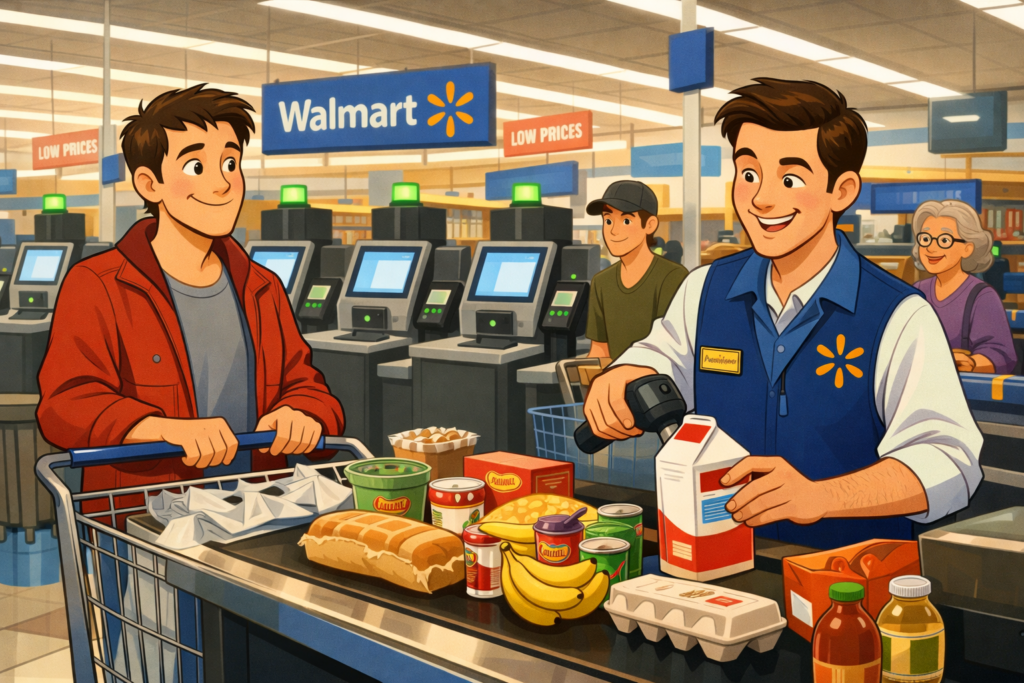
Speed feels good … until something goes off the rails real fast.
You may have noticed something changing in big U.S. retailers without much fanfare.
Target and Walmart have been pulling back on self-checkout. Removing ALL such lanes in some cases, and reducing them in others.
The headlines frame this as friction versus efficiency. I don’t believe that’s the real story.
I appreciate a speedy, knowledgeable, well-trained cashier.
I dislike standing frozen at a self-checkout waiting for “assistance” when a scanner hiccups or an item won’t register. (Or when I fail as an unpaid bagger.)
That’s not frictionless. That’s neglected and abandoned.
Retailers are responding to theft, errors, and throughput issues, yes.
But more interesting is what they are re-introducing by design: control, accuracy, and trust.
The assumption that “less friction always converts better” is proving untrue here.
For product makers, this is relevant because many products have been designed for a world where no one explains anything.
No one recommends; nobody catches mistakes, until it’s too late.
Packaging, naming, sizing, and instructions have all been forced to stand alone like this.
Suddenly, human-mediated moments are creeping back in.
That raises an uncomfortable but useful question:
What decisions did YOU make assuming no one would need to help the buyer, and are those now liabilities or ripe opportunities?
What if the job isn’t to remove people from the process, but to design the very best way for them to help when needed.
Want to make your product irresistible? That’s what we do as product marketing consultants at Graphos Product, helping innovators turn need-driven ideas into market-ready successes.