
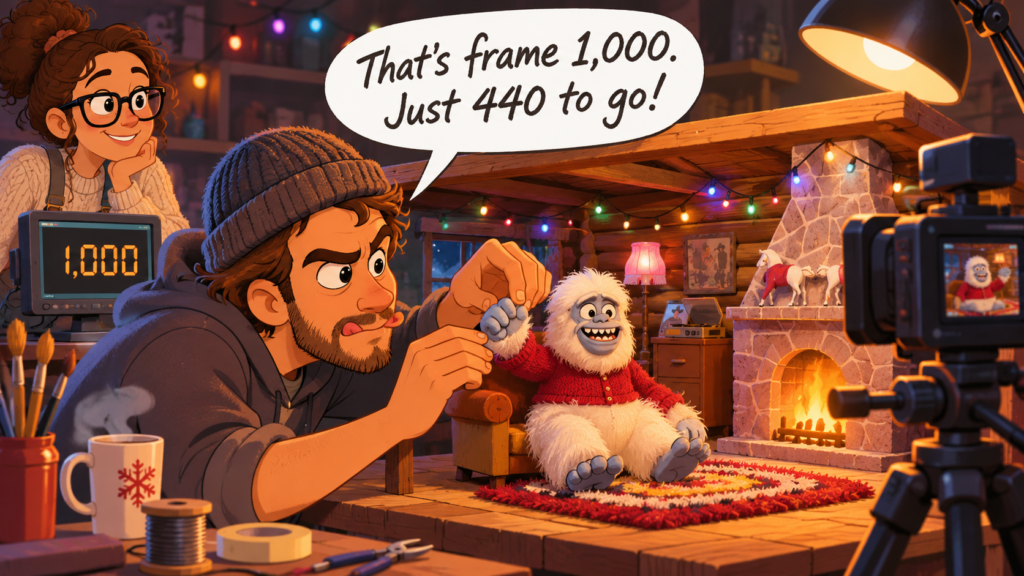
AI is making polished imagery easier than ever. Levi’s and E.L.F. are betting folks will notice when humans do the hard part instead.
As a kid, I was fascinated by stop-motion animation.
Something like Rudolph the Red-Nosed Reindeer seemed insane once you grasped how it was made.
The 1964 special used handmade four-inch puppets across 22 miniature sets, with 24 painstaking frames required for every second of animation.
That’s like, 1,440 individual photos for every single minute.
Now Levi’s has gone wa-aay back there.

Its new holiday campaign, Let’s Get Fuzzy, stars a stop-motion yeti named Gus.
The sets, characters and tiny Levi’s outfits were made by hand, and Levi’s says filming took four hours for every second of finished animation.
E.L.F.’s first holiday campaign goes even further into the handmade aesthetic, with individually sculpted characters and elaborate miniature sets.
Its entire animation team and 90% of the puppet crew were women.
This reminds me of Apple Music’s new identity, where the team physically vibrated mineral oil with sound rather than simulating the effect digitally.
All three could have taken so much easier routes.
More and more, that’s the point.
Gallup found 66% of Americans aged 18–29 view businesses using AI to create ads negatively, while 73% consider AI-generated people or voices unacceptable.
I don’t think consumers are suddenly hating on technology. But they’re definitely getting better at spotting when tech replaces the stuff they value.
Craft creates evidence of intention: someone crafted that whole miniature room.
Somebody adjusted those tiny puppets, bit by bit.
Folks spent four hours producing each second we’ll watch with one chew of our breakfast.
As AI makes production dramatically easier, visible effort becomes more unusual.
And unusual is something we actually value.
If you’d like help creating and marketing products people feel compelled to buy, the product marketing consultants at Graphos Product can help.