
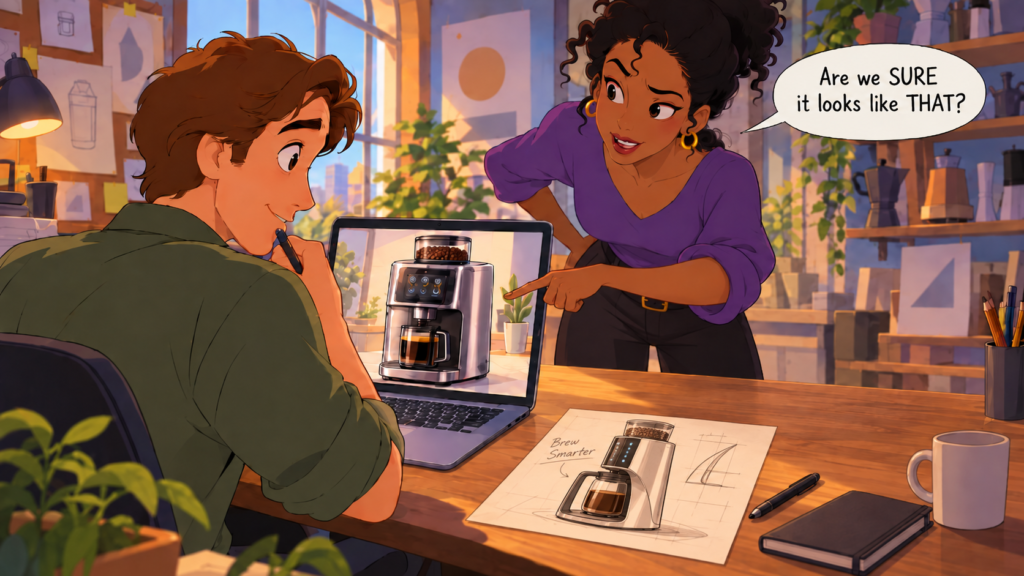
New research suggests the best way to use generative AI for product ideation is to add on MORE constraints.
When innovators use AI to develop a new product idea (or any creative idea), there’s an obvious temptation:
Show me what it looks like.
That can be useful early on. But new research suggests it can also be a trap.
A 2026 study in Information Systems Research examines how people refine ideas with AI-generated text versus AI-generated visuals.
The researchers found that textual concretizations coughed up ideas that were 18% more creative than visual concretizations, although they took 30% more effort from the person doing the ideation.
The reason might surprise you.
Text gives you something to work with, but it leaves gaps.
You still have to imagine how the product behaves, what it looks like, who might use it and how the pieces fit together.
AI gives structure, but the human at the keyboard still has to complete the picture.
A generated image does way more of that work for you.
It chooses the shape, materials, proportions, colours, details and overall form. That can make a vague idea suddenly seem tangible, which is useful when the concept is still very immature.
But once the idea becomes more developed, those visual decisions can start closing doors.
The researchers found that visuals helped creativity for very immature ideas without increasing effort.
As ideas got more specific and actionable, though, text got more useful because it left greater room for human elaboration.
That’s highly relevant to product development right now.
AI image generators can generate a convincing concept rendering in seconds. For a founder, designer or engineer, seeing the imagined product can be kinda exhilarating.
It can also make one version of the idea seem more flushed-out than it really is.
Once you’ve seen the sleek and shiny enclosure, rounded corners, modern control layout and brushed metal finish, it becomes harder to imagine that the product could have been even better as something totally different.
The image gives the idea authority.
Text, on the other hand, keeps it negotiable.
I use generative AI daily, and I think visual tools are extraordinary. The rate of improvement blows my mind. And this research shows their timing in the workflow deserves more thought.
Early in ideation, a visual can stir up possibilities you would not have considered. That’s cool. It empowers us to do better and better rather than just faster and faster.
And when you’re still working to improve the underlying concept, it might be best to ask AI to throw you some alternatives, challenge your assumptions, propose alternate use cases or develop the idea in words before asking it to draw anything.
The extra effort could achieve real, valuable differentiation.
One of the ideas I explore in I Need That is that product teams can become attached to solutions before they’ve fully understood the need they’re solving.
AI has the power to accelerate that process dramatically.
Which means the question isn’t if AI can make your idea concrete. It sure as heck can.
It’s when making it concrete is too soon.
If you’d like help creating and marketing products people feel compelled to buy, the product marketing consultants at Graphos Product can help.