
New research suggests customers experience craftsmanship through the people, timing and tiny gestures surrounding the product, beyond how it was made.
When brands talk about craftsmanship, they usually point backward.
You know, stuff like stitching all done by hand. Wood lovingly shaped by some grizzled artisan.
Maybe it’s the chef who trained in obscurity for decades. Or the watch assembled from hundreds of teeny individual components.
For sure, all that kind of thing adds value for the buyer.
But new research in the International Journal of Research in Marketing shows craftsmanship is also something customers experience right in the moment.
The researchers studied a fine-dining restaurant in France and identified THREE ways craftsmanship gets enacted during service: featuring excellence, sharing passion and orchestrating time.
The customer doesn’t stop at appreciating skill from a somewhere else that happened weeks or months ago.
Staff make craftsmanship tangible through how they explain, present, pace and interact.
That idea goes way beyond restaurants.
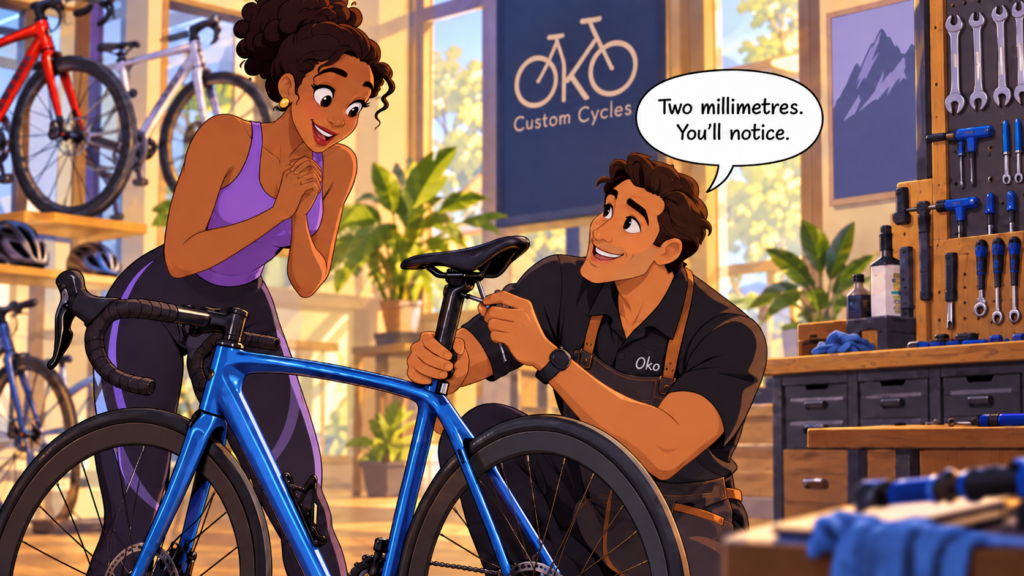
Think about buying an expensive new road or mountain bike.
The craftsmanship may be in the carbon layup, frame geometry and component selection.
But as a customer, you experience it first-hand when the expert in the shop notices how you ride, adjusts the fit by a few millimetres, explains why a particular setup suits you and takes the time to get it absolutely perfect just for you.
Or it could be a high-end audio system.
The engineering is gonna be exceptional, but the sense of expertise grows when someone positions the speakers carefully, listens with you, makes micro-adjustments and passionately explains the subtleties in what they’re hearing.
Those little interactions become central to the product experience.
The researchers call attention to micro gestures, the relationship between what happens backstage and what the customer sees frontstage, and the role customers themselves play in interpreting craftsmanship.
That’s SO important, because many brands lean hard into the word craft while doing precious little to help customers deeply, clearly experience it in their own lives.
Sure, those brands put up a picture of the workshop in black-and-white and tell the founder story.
And maybe they slap “handcrafted” on the packaging.
Then the real buying experience is a checkout page, an automated confirmation and a brown box on your porch.
Efficiency is pivotal to scaling and being profitable, but premium products often derive part of their worth from hard proof that somebody, somewhere truly cared.
As more interactions get automated, that human evidence will become even MORE distinctive.
The researchers make that point explicitly in their conclusion: as AI and automation make market interactions increasingly impersonal, craftsmanship has a chance to operate as a counterforce by making skilled human work visible again.
So, if you’re really an artisan, other people’s AI is YOUR advantage. Wow… how’s that for a reversal?
One of the ideas I dig into in I Need That is how customers never experience a product as a big pile of attributes. They take in everything around it, and appreciate how the sum total makes them feel.
If craftsmanship is part of your value prop, don’t leave it all in the factory.
Bring special pieces of it right into the customer encounter.
Let ’em see the precision, hear your expertise and savour the extra care.
That’s where craftsmanship becomes something with standout value.
If you’d like help creating and marketing products people feel compelled to buy, the product marketing consultants at Graphos Product can help.