

Casio’s new F-B100W shows how innovation can mean adding exactly enough technology, then stopping.
The Casio F-91W is one of those rare products that seems almost immune to progress.
It debuted in 1989, when I was a teenager and Taylor Swift was a newborn.
Thirty-seven years later, Casio STILL makes it.
You can buy a new one for about $20, and it does what it always did: tells time, runs a stopwatch, sounds an alarm and lights up when it’s dark.
The battery lasts about seven years.
Now Casio has done something I find much more interesting than building another smartwatch.
It made the F-91W a wee bit smarter.
The new F-B100W keeps the wonderfully retro rectangular design, weighs only 26 grams and adds a step counter.
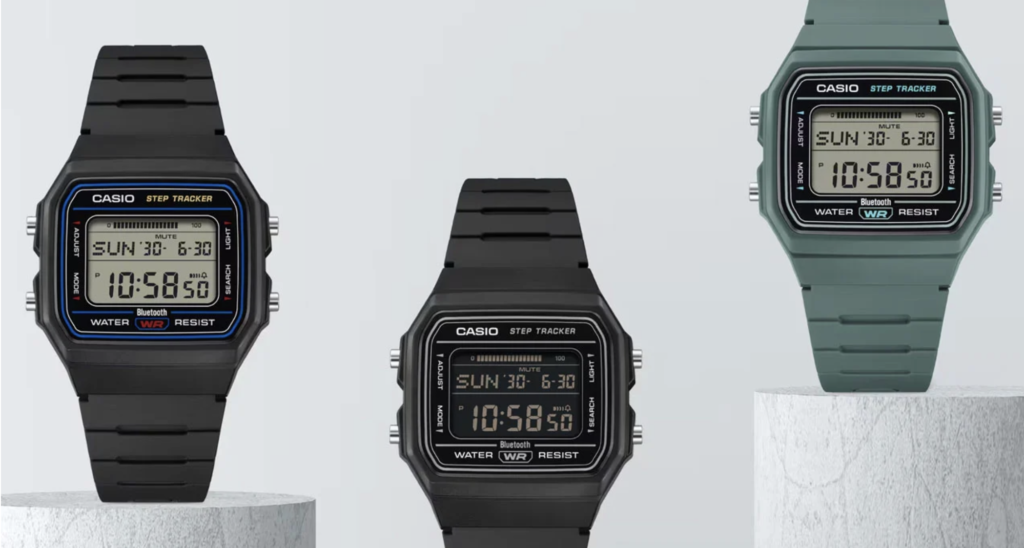
Bluetooth connects it to your phone so the time stays accurate, settings can be managed through Casio’s app, your walking data can be logged and you can find your phone when you’ve misplaced it.
There’s also a 200-lap stopwatch, five alarms plus a more useful LED backlight.
And then Casio stopped.
No big-ass OLED screen.
No notifications buzzing on your wrist, apps beggin’ for attention, or nightly charging ritual.
Pop in a new battery in about two years, and you’re golden for another two.
That’s an increasingly attractive proposition in 2026.
We’ve spent years watching companies cram more tech into stuff just because they can.
Watches became tiny computers. Cars turned into rolling walls of touchscreens. And even refrigerators acquired internet connections and big, bright screens to make them obsolete in a few years instead of thirty.
But consumers also got increasingly interested in products that create some distance from all that anxiety-inducing tech dependency.
I‘ve written about research showing people deliberately separating themselves from their smartphones, and the resulting market for dumbphones, phone-locking products and even docks that turn smartphones back into wall-mounted telephones.
The F-B100W fits neatly into that same emerging need.
It gives you one of the functions many people genuinely value from a fitness tracker, how much did I move today?, without asking you to strap another attention machine to your body.
Casio launched it in Japan this month for ¥8,800, about US$55. All three variations reportedly sold out from Casio’s online store within hours.
That doesn’t prove EVERYONE wants less technology.
But it does provide a useful clue about product development in a world going all-out for deeper and deeper tech.
One of the ideas I explore in I Need That is that innovation should begin with the life customers are trying to create, then work backward to the product that helps them get there.
That makes restraint an underrated product-development skill.
Ask what your customer needs next.
Add that … and have the courage to leave everything else out.
Casio got the F-91W amazingly right 37 years ago.
Perhaps the smartest thing about its successor is how LITTLE they decided to fix.
If you’d like help creating and marketing products people feel compelled to buy, the product marketing consultants at Graphos Product can help.