
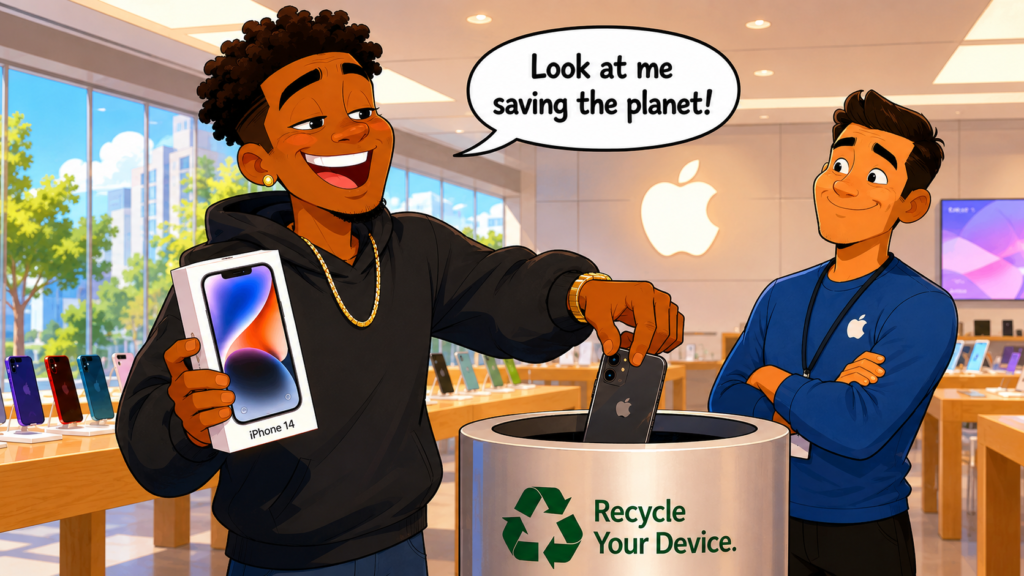
The things that ease our conscience can open our wallet. But what if those are at odds?
Have you noticed that the companies talking most about sustainability also seem really good at selling us more new stuff?
Take Apple.
The company has spent years highlighting recycled aluminum, renewable energy, carbon-neutral initiatives, and environmental progress.
Meanwhile, millions of people still find themselves eyeing the latest iPhone every September.
A new study suggests those two things seem to be more connected than they appear.
Researchers found that when luxury brands promote environmentally friendly products, consumers become MORE willing to buy the brand’s less sustainable products afterward.
The researchers call it a form of moral licensing. The brand earns moral credit, and so we feel more comfortable spending it.
It’s a fascinating, totally ironic idea.
Imagine Apple introduces a new product made with recycled materials. A customer sees the announcement, feels good about the brand … and decides to upgrade their perfectly functional phone.
The sustainable product just justified it.
This doesn’t mean the environmental initiatives are fake. Or that consumers are being deliberately manipulated.
It DOES highlight something marketers have understood for a long time: every new message changes the context around every other message.
The more clout the messenger carries, the bigger the contextual update.
And the lesson goes way beyond sustainability.
When people believe a brand is responsible, ethical, innovative, or generous, those positive feelings rarely stay confined to one product.
They spill over and the halo grows.
And what if that halo creates more consumption than the thing that created it?
(If you’re reading this on an iPhone that replaced another perfectly good iPhone, you’re hardly alone.)
Want to make your product irresistible? That’s what we do as product marketing consultants at Graphos Product, helping innovators turn need-driven ideas into market-ready successes.