
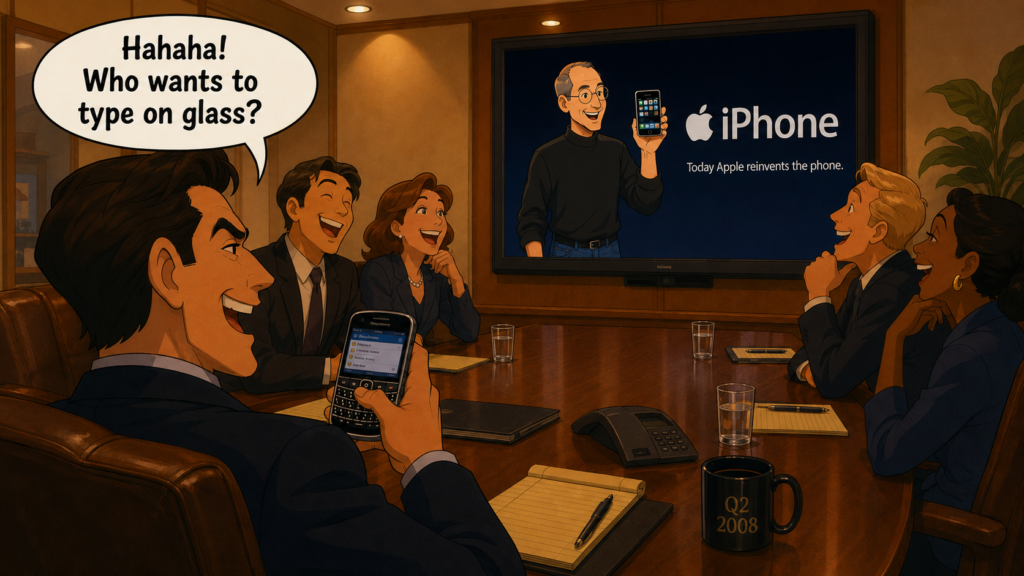
What if the market changes faster than the customer you built your whole business around?
As a Canadian, I remember feeling really proud of BlackBerry.
Back when it was called Research In Motion (or RIM), the company felt unstoppable.
Business leaders flaunted BlackBerrys everywhere. Governments depended on them. And executives treated the keyboard like an extension of their hand. They LOVED it.
My colleagues Andreas kept using his BlackBerry long after most people had moved on. He refused to abandon the physical keyboard and held onto the device even after support effectively disappeared.
Lots of people felt that way.
That’s why the usual version of the BlackBerry legend misses something important.
The company didn’t collapse because it ignored its customers.
In many ways, it listened to them much too well.
Like Andreas, its enterprise users cared deeply about security, email efficiency, battery life, AND tactile typing. Early reactions to the iPhone often reflected skepticism about touchscreens and virtual keyboards, including (especially) from BlackBerry leadership itself.
The real problem was bigger than product preference among the diehards.
The centre of gravity in the market shifted, in a gigantic way.
As smartphones became personal lifestyle devices rather than primarily corporate tools, consumers started influencing workplace technology choices through the rise of bring-your-own-device culture.
All of a sudden, employees expected their personal phones to handle work email, calendars, and messaging, and companies adapted en masse around that behaviour.
That changed who mattered the most in the grand scheme.
BlackBerry had totally optimized itself around institutional buyers while the much larger (and growing) market moved toward emotionally driven consumer adoption.
The lesson for founders is tough to swallow because it goes against the theory of cult loyalty being enough.
Plus, it shows that customer research CAN be accurate and still leave you screwed. Blackberry’s data clearly proved customers did not want to give up their keyboards and legendary security.
BUT your data only reflects the worldview of the customer you ask.
If the market begins reorganizing around a totally different buyer, a different motivation, or a new, bigger use case (or ALL these), the answers can be technically correct yet strategically fatal.
Most BB users weren’t even buying their own devices. And when they did, many chose something different.
That’s why product builders need to watch adjacent behaviour, and not get deked out by direct feedback.
And meanwhile, the future storms in through the side door.
What kind of assumptions (or even truths) about your current customer might stop you from seeing the NEXT customer clearly?
Want to make your product irresistible? That’s what we do as product marketing consultants at Graphos Product, helping innovators turn need-driven ideas into market-ready successes.