
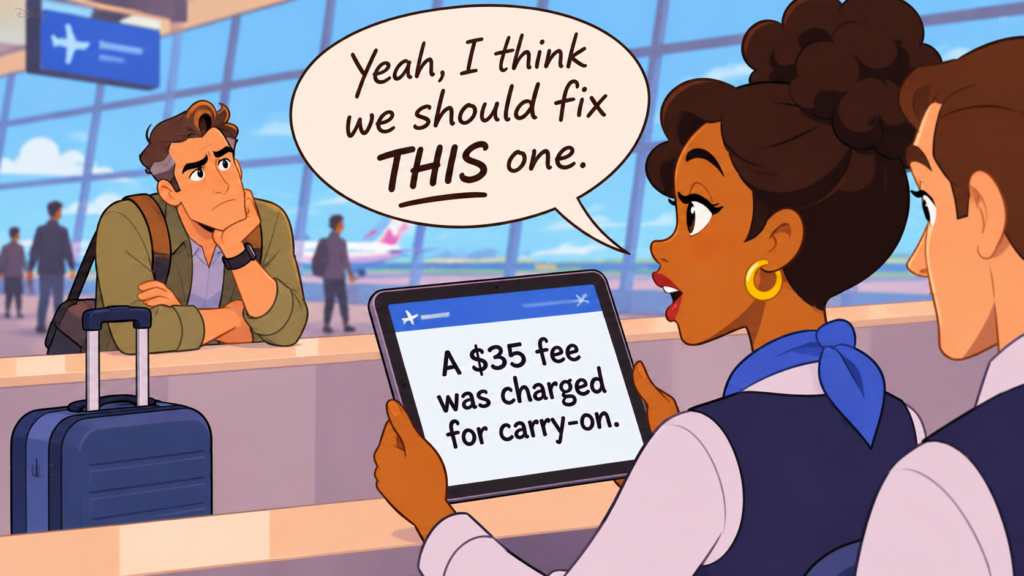
The way an angry customer structures a sentence can reveal more than the complaint itself.
My eighth-grade English teacher told me to avoid passive voice because it makes writing weaker.
Even Microsoft Word drove home the message, highlighting that kind of construction.
Turns out bad old passive voice can also make customer complaints more revealing.
A new study in the International Journal of Research in Marketing analyzed more than 160,000 real complaints filed with the U.S. Consumer Financial Protection Bureau… then followed up with FIVE additional studies.
The finding: customers who use passive constructions are more likely to escalate a complaint.
In the field data, each additional passive-voice sentence corresponded with about a 4% increase in the likelihood of disputing the company’s proposed resolution.
The interesting part is why.
Passive voice itself doesn’t cause escalation. But it tells you where the customer places responsibility.
Compare:
“I entered my PIN incorrectly.”
with:
“The PIN got rejected”
The second version removes the customer as the responsible party. Who does that leave?
Across several experiments, when people believed the company was responsible for the bad experience, their complaints contained more passive voice.
In one study, participants describing company-caused problems used roughly 50% more passive constructions than those describing problems they caused themselves.
That flags an opportunity for companies handling thousands of complaints.
Most service systems already look for angry words, sentiment and severity. But grammar itself can contain another signal.
A complaint saying “I forgot the code” is psychologically different from “access was denied.”
The customer might never write, “I blame YOU.”
But their syntax says it for them.
With AI already reading customer-service interactions at scale, that kind of signal could help companies identify which complaints deserve faster attention, a better recovery offer or a human being before the customer decides to make the problem way bigger.
If you’d like help creating and marketing products people feel compelled to buy, the product marketing consultants at Graphos Product can help.