
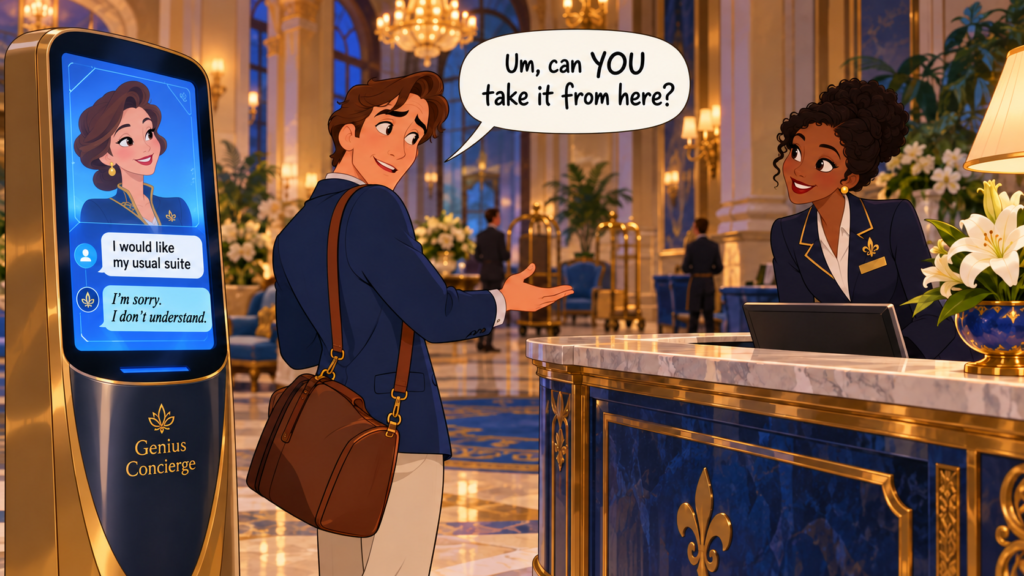
Affluent customers might welcome AI assistants, but premium service means knowing when a human needs to take over.
Luxury service has traditionally meant high touch.
Like a concierge who remembers your preferences or the salesperson who knows your size by heart.
Maybe the hotel that anticipates what you’ll need before you step onto the shiny tiles.
But the luxury consumers I know are also super-interested in AI agents and automation.
Why wouldn’t they be?
If an agent can book the restaurant, change the flight, locate the exact product, arrange delivery and save 20 minutes of pointless back-and-forth, that’s an all-round better experience.
What they’re paying for is access to fantastic service, not max human interaction.
A recent study in the Journal of Retailing and Consumer Services provides some neat support for that idea.
Researchers examined attitudes toward AI assistants among luxury consumers in South Korea, a market with unusually high luxury spending and technology adoption.
They found that emotional appeal and perceived social presence both helped drive acceptance of AI assistants. Trust also played an important role.
But one other result gets me: performance expectancy itself did not significantly predict intention to use the AI.
Ease of use, social influence and the conditions supporting its use DID, though.
I sure wouldn’t interpret that as luxury customers being indifferent to performance. If anything, I think the bar is higher.
They expect the technology to be worthy of its place.
The interesting bit begins after that.
Google made this especially timely last week with the release of Gemini 3.8 Live with Live Avatar for enterprise customers.
Companies can now build conversational video agents with synchronized speech, realistic facial expressions and custom personas.
Google positions them for websites, mobile experiences and interactive kiosks.
It isn’t hard to imagine a luxury hotel, airline, jeweller or fashion house giving its AI concierge a beautifully designed face and eloquent, courteous speech patterns.
I’m less convinced that the well-mannered simulation is where the value will come from.
If the AI instantly understands that I need dinner for six near my hotel, remembers that my wife eats gluten-free, checks availability and books the right table, we’re golden.
If a beautifully rendered avatar smiles at me while misunderstanding the request three times, luxury just got worse than filling out a crappy form.
And if I finally type HUMAN PLEASE and nobody shows?
That could easily be enough to lose a high-value customer.
The lesson for luxury brands may be that automation and personal service ain’t mutually exclusive.
Use AI where speed, memory and convenience make the experience better. Keep humans immediately available for judgment, reassurance, exceptions and the moments where folks really want personal attention.
The handoff could even become one of the most important pieces of the experience.
One of the ideas I explore in I Need That is how frustration can neutralize desire re-eeal fast.
Premium pricing raises expectations even further because customers know they have PAID to avoid the pedestrian grief.
Luxury customers can sometimes be totally happy talking to an AI.
Might even prefer it.
But then, when the AI stops killin’ it, premium service means pulling AI the hell out of the way.
If you’d like help creating and marketing products people feel compelled to buy, the product marketing consultants at Graphos Product can help.