
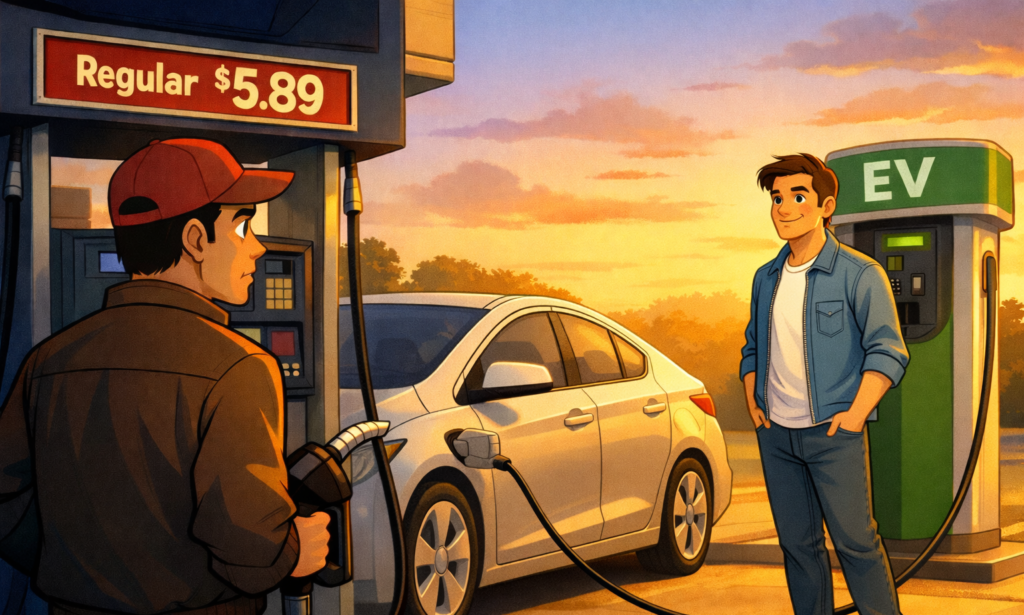
Adoption curves can change faster from geopolitics than from product innovation.
Tension around the Strait of Hormuz has pushed oil prices up at historic rates.
That narrow passage carries a significant share of the world’s oil supply. When flows are threatened or restricted, prices react quickly.
And when fuel prices jump, human behavior follows.
In China, EV adoption was already strong. Now it’s accelerating further.
In Europe, the same pattern is plainly visible. Higher fuel costs make the operating economics of electric vehicles even more attractive.
In the U.S. and Canada, where adoption has been sluggish, spikes like this tend to remove hesitation.
The interesting part is not that EVs benefit.
It’s how little control product teams and marketers have over the trigger.
For years, automakers have worked to improve range, charging infrastructure, and price parity. Those matter, but they move slowly.
A geopolitical event moves instantly.
What looked like a gradual transition becomes a sharp inflection.
The buyer doesn’t suddenly love EVs that much more.
The context got changed.
Total cost of ownership for gas roars up.
Risk perception over EVs hums down.
What felt like an early adoption decision starts to feel like a timely, practical one.
This is what product strategies don’t integrate well.
Adoption is rarely linear, and it’s rarely driven only by the product itself.
External forces can compress years of hesitation into a few months.
Or stall momentum just as quickly.
The lesson is not to think you can predict these events. Nobody can.
It’s to recognize how exposed your category is to them.
What external shift could suddenly make your product the obvious choice?
Want to make your product irresistible? That’s what we do as product go-to-market experts at Graphos Product, helping innovators turn need-driven ideas into market-ready successes.