
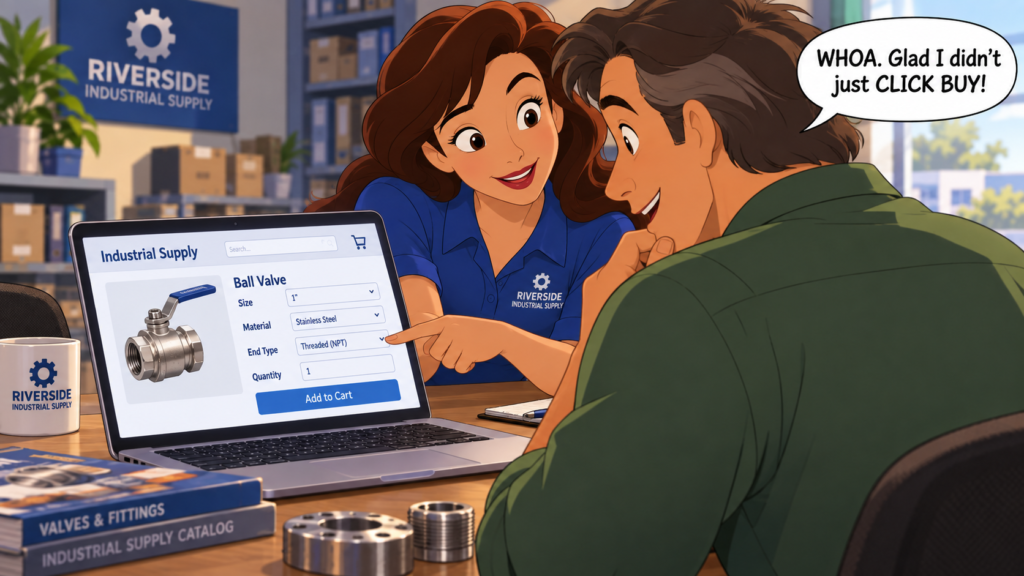
Selling online can expand a B2B company’s reach, but new research shows it can also weaken the consultation customers rely on.
I’ve helped lots of B2B companies sell online, and one thing always surprises them:
Putting products on a website is the easy part.
The heavy lift is changing how the company thinks about sales.
That becomes even more obvious when a traditional B2B seller adds a direct-to-customer or self-service channel.
Now all of a sudden, the sales folk are longer the only route to the product!
Customers get to research, reorder and buy without speaking to a single person.
Sounds super efficient, huh?
And according to a new study in the International Journal of Research in Marketing, it kinda is.
Researchers studied an industrial distributor that introduced an e-commerce channel, using more than 20,000 monthly observations from 845 salespeople, then followed up with two experiments involving another 551 salespeople.
The online channel increased the average number of invoices salespeople generated per customer and helped them handle more customer interactions.
BUT (drum roll… ) there was a tradeoff.
Consultation quality declined.
Customers using self-service were way more likely to wind up in a channel that didn’t match the complexity of what they needed, which increased the risk of poor purchasing decisions and returns.
That nails something I’ve seen again and again.
A good B2B salesperson does tons and tons much more than take an order.
They know that Customer A can safely reorder the same component online for the hundredth time.
Customer B, on the other hand, is sure as heck gonna specify the wrong product for a $40,000 application and urgently needs somebody to intervene.
E-commerce, even with AI, doesn’t know the difference.
The study’s recommendation is essentially a hybrid model: send routine transactions online and preserve human consultation where the buying decision actually requires it.
The researchers even suggest safeguards such as salesperson approval for complex purchases or prompts that encourage customers to ask for help when the risk of error is higher.
There’s another finding I think B2B leaders should pay close attention to.
Telling the sales team that e-commerce is good for them didn’t much change the outcomes.
Paying ‘em for e-commerce revenue did.
When salespeople received credit for online revenue, they handled more interactions while doing a better job matching customers to the appropriate channel.
If you’ve got a human brain, that makes sense.
If you build a digital channel that your salespeople perceive as competing with their commissions, you’ve created an organizational fight before the customer has even logged in.
Grainger is a great example of how far B2B digital selling can go when it becomes part of the business model rather than an add-on.
The industrial supplier was generating 65% of its revenue through online channels as far back as 2020, while still emphasizing deep product expertise and high-touch customer service.
Its current strategy explicitly separates a North American “High-Touch Solutions” business from its digitally oriented “Endless Assortment” businesses like Zoro and MonotaRO.
THAT’s closer to the mindset B2B companies need.
Online selling is a LOT more than a fun new website project.
It changes which customers salespeople spend time with, which purchases should be self-service, how compensation works, how customer support is delivered, and where expertise belongs in the buying journey.
One of the ideas I dig into in I Need That is how adoption requires removing unnecessary resistance without eliminating the help customers genuinely need.
B2B e-commerce can do both extraordinarily well.
But only if the company redesigns the selling system around it.
If you’d like help creating and marketing products people feel compelled to buy, the product marketing consultants at Graphos Product can help.