

More than 40 years ago, Jobs described how computers would preserve a person’s worldview, answer questions and act as personal agents.
Steve Jobs gets credited with predicting a ton of stuff after the fact.
But this one’s especially hard to dismiss.
At the 1983 International Design Conference in Aspen, Jobs talked about the limitations of books.
He loved how they let you access Aristotle or Plato directly, without an intermediary. But books disappointed him in one big way.
You couldn’t ask Aristotle a question.
Jobs imagined something very different. What if a machine could capture a person’s “underlying spirit,” principles or way of looking at the world?
Maybe, long after that person was gone, you could ask the machine what Aristotle might have said and get a realistic answer.
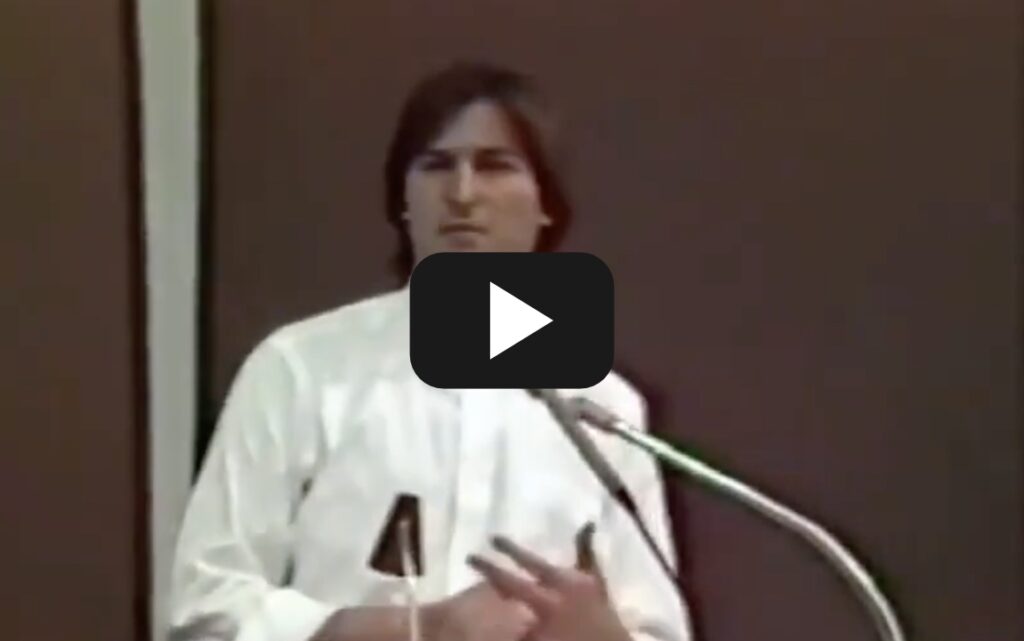
That sounds remarkably close to what generative AI now does.
Not perfectly, of course. Jobs himself acknowledged that such a system might get the answer wrong.
But the concept is pretty striking: preserve enough of a thinker’s worldview that a future user can interact with it instead of only reading it.
A year later, he’d obviously chewed on that and pushed the idea further.
In a 1984 interview, Jobs described the next stage of computing as “agents.”
Computers of the day were responders, he said: you told them what to do and they did it.
Future computers would begin anticipating what you wanted, guiding you through information and being like a “little friend” inside the machine.
He even imagined carrying around a small slate that gradually learned about you, remembered your routines and offered to handle recurring tasks automatically.
That sounds less like the Macintosh of 1984 and lots more like the AI agents companies are racing to build today.
Did Steve Jobs literally predict ChatGPT?
Nope.
He wasn’t describing transformer models, LLMs or the technical path that got us here.
What he did amazingly well was imagine the human outcome before the tech even existed to deliver it.
Instead of asking what computers would become technically capable of doing, he asked what people would eventually want from them.
A machine you could chit-chat with, about anything.
One that understood a body of knowledge deeply enough to answer important questions.
That continuously learned about you.
And even began acting on your behalf.
Even if you’re a major Jobs-hater, you’ve gotta be a little impressed.
What he did there is a useful product-development skill in any era.
One of the ideas I explore in I Need That is that breakthrough products rarely begin with a specification sheet. They begin with a better understanding of the experience people would value if someone could make it possible.
Jobs was looking at the computers of 1983 and seeing wa-aaaaaay beyond the box.
He was imagining the potential relationship.
Forty-three years later, we’re finally building a lot of what he described.
If you’d like help creating and marketing products people feel compelled to buy, the product marketing consultants at Graphos Product can help.