
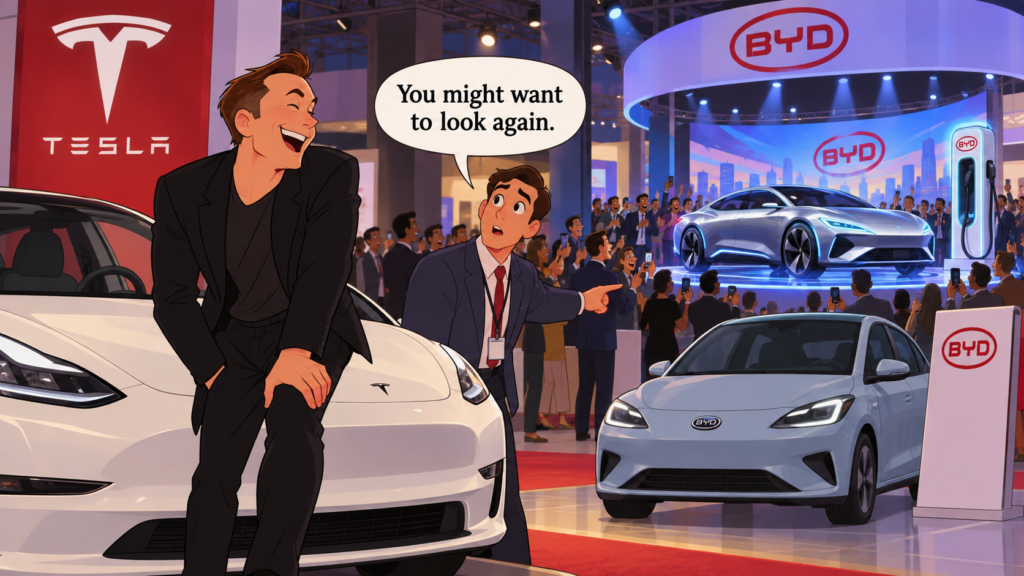
In 2011, Elon Musk laughed when BYD was suggested as a Tesla competitor. Fifteen years later, the joke has aged badly.
There’s an old clip of Elon Musk that has become much more intriguing with time.
In a 2011 Bloomberg interview, he was asked if Chinese automaker BYD could become a serious competitor to Tesla.
Musk laughed.
Then he famously asked:
“Have you SEEN their car?”
He went on to say BYD didn’t have a great product, its technology wasn’t very strong, and the company had serious problems in China.
The clip is real, and Musk later acknowledged how much had changed, writing in 2023 that BYD’s cars had become “highly competitive.”
Today, the laughter is totally in the opposite direction.
In 2025, BYD sold about 2.26 million battery-electric vehicles, overtaking Tesla’s 1.64 million deliveries to become the world’s largest BEV seller for the year.
BYD had already become China’s largest automaker by sales, and its international expansion has accelerated sharply.
In August 2026 alone, overseas shipments were up 134.5% year over year, and BYD generated more revenue outside China than inside it during the first half of the year.
The product story is even wilder.
BYD started as a battery company, not even a car company.
That background helped it build a level of vertical integration that Charlie Munger spotted early. In 2009, he called BYD a “damn miracle,” pointing out that it made almost everything in the car itself.
Warren Buffett later said Munger deserved “100 percent of the credit” for Berkshire Hathaway’s investment.
And that capability keeps on showing up in the products.
In 2025, BYD unveiled a 1,000-volt “Super e-Platform” capable, under its stated conditions, of adding about 400 kilometres of range in five minutes at a peak charging rate of 1,000 kW.
That’s twice the peak power of Tesla’s then-latest Supercharger hardware.
It’s a mind-blowing reversal.
But the useful lesson isn’t what a dumbass Musk was in 2011. BYD’s cars WERE far less competitive then, and Tesla was poised to redefine what an electric car could be.
The mistake is what can happen AFTER that first judgment.
Once a competitor is filed away as inferior, every weak signal tends to reinforce the same story:
Cheap. Clumsy. Copycat. Nothing to see here.
Meanwhile, the competitor keeps learning.
Improving the battery, the design, and manufacturing. Expanding distribution and lowering cost.
Then one day you look over and discover that the company you laughed at has become the benchmark in areas you used to own.
I see this in product categories all the time. Established companies monitor the competitors that already look dangerous while overlooking the ones that look slightly ridiculous.
That can be a frigging costly filter.
One of the ideas I dig into in I Need That is how buyers reward the product that solves their need best, regardless of what incumbents think of the company behind it.
A competitor doesn’t need your respect to improve.
And if dismissing them makes you laugh, it may be worth taking a much closer look.
If you’d like help creating and marketing products people feel compelled to buy, the product marketing consultants at Graphos Product can help.