
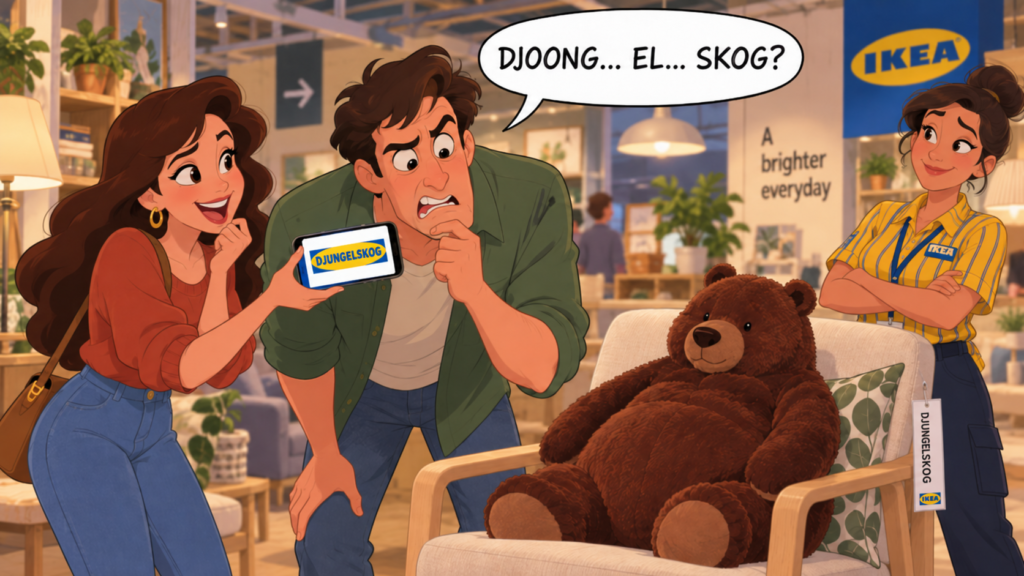
One of IKEA’s weirdest brand quirks has become a game, and a pretty good lesson in how to turn confusion into engagement.
I’ve joked before about IKEA’s remarkable ability to give products names that are almost universally unpronounceable outside Scandinavia.
Some are super easy.
BILLY.
LACK.
Although I still wonder who but IKEA would ever look at a product and decide, “LACK… perfect!”
Then there are beauties like DJUNGELSKOG, BREVBÄRARE and SKÄMTSKÅL.
You can teach me those today and I guarantee the required lingual acrobatics will be gone from my brain tomorrow.
And when we’re actually shopping at IKEA, I’d wager 99% of us don’t even bother trying.
More likely, we’ll say things like:
“The chunky black shelving unit.”
“The cute little white table.”
“That tall cabinet thingy we saw downstairs.”
IKEA knows this better than you or I do. And now it’s laughing along with us.
Its new Swedish Test turns the problem into a TikTok pronunciation game. You try saying IKEA product names into your phone.
Get one wrong and you get the game-show buzzer.
BUT get ’em right and you progress to harder names, with the chance to win an IKEA gift card.
The campaign reportedly has people spending an average of more than two minutes interacting with the brand.
That’s a lot of attention generated by something that, on paper, sounds like a usability flaw.
And there’s more history behind those strange names than I realized.
IKEA founder Ingvar Kamprad had difficulty remembering numerical product codes, so he began using proper names and words instead.
That eventually evolved into a structured naming system tied to Scandinavian places, people and other categories. IKEA itself now describes that system as part of its identity.
Earlier this year, IKEA even added pronunciation audio directly into its app, letting customers hear how names such as POÄNG, KLIPPAN and KALLAX are actually supposed to sound.
So this campaign does something clever.
It takes a piece of friction that could easily be viewed as a weakness and turns it into participation.
The names already make IKEA distinctive. Nobody else does it so weirdly, and succeeds.
Now the difficulty itself becomes entertainment.
People laugh when they fail.
They try again.
And they share it.
And then, almost accidentally, they learn a little more about the products and the brand.
One of the ideas I explore in I Need That is that distinctiveness often comes from characteristics competitors would be reluctant to copy.
Any ol’ furniture retailer can sell a bookshelf.
Very few could dub one KALLAX, watch millions of customers butcher the pronunciation for years, then spin that collective failure into a viral marketing campaign.
That’s brand equity, uniquely played.
The smartest part may be how IKEA isn’t trying to fix the joke, but joining it.
If you’d like help creating and marketing products people feel compelled to buy, the product marketing consultants at Graphos Product can help.