
New research shows that uncertainty makes a reward more desirable.
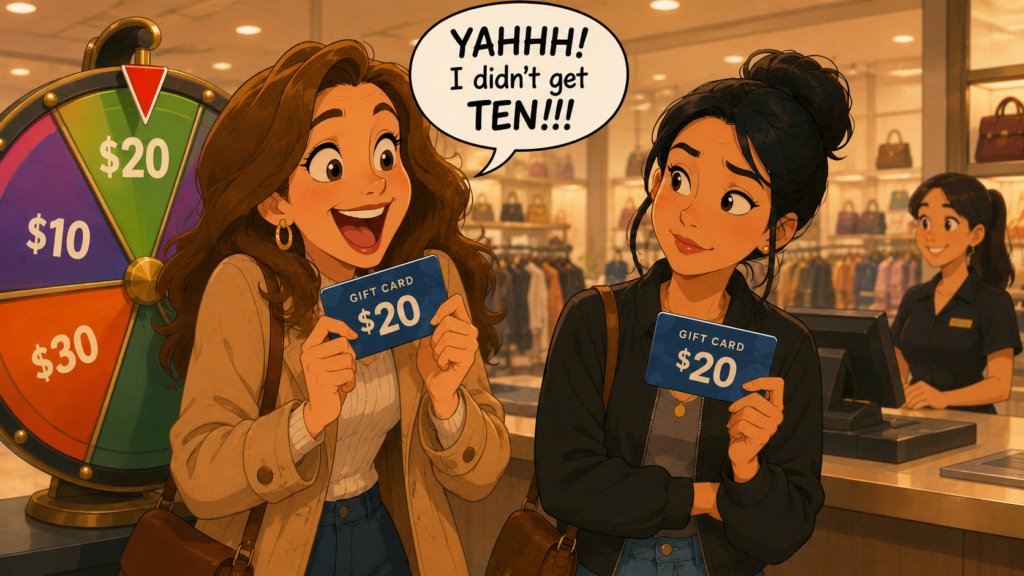
Imagine two people each receive a $20 gift card.
One is simply handed the card.
The other spins a prize wheel offering $10, $20 or $30, and happens to stop on $20.
Both got the same card, and the exact same value.
But the second person likes theirs MORE.
That’s the cool finding from new research involving seven preregistered experiments and more than 12,000 participants.
The researchers call it the “uncertainty spillover effect.”
The mechanism is beautifully human.
Once you win $20 from a range that included $10, your brain keeps that worse possibility alive:
Hey, I coulda only gotten ten bucks.
That comparison makes $20 seem a little lucky.
In one experiment modeled on Priceline, 89% of participants chose a discounted hotel when it emerged from a mystery group of possible hotels, versus 76% offered exactly the same hotel and price directly.
In another, participants who “won” a $25 Amazon gift card from a $15-to-$35 lottery were more reluctant to trade it away than people who were simply given the identical $25 card.
And the effect can spill beyond the prize.
Participants given an Italian coffee sample through a mystery draw were more likely to continue a paid coffee subscription afterward, 45% versus 39%.
That gives marketers something interesting to work with.
Mystery coupons. Prize wheels. Random upgrades. Unknown welcome gifts.
We often use these devices because anticipation makes promotions entertaining.
This research suggests the value can survive after the uncertainty is resolved.
There is (as always) an important catch.
It only works when customers can easily imagine a worse outcome.
Participants who received the worst possible prize got no boost at all.
And with losses, the effect actually reversed because people started imagining how much better things could have gone.
One of the ideas I dig into in I Need That is that perceived value rarely resides entirely inside the product.
Customers evaluate what they received against alternatives, expectations and the story surrounding the acquisition.
Apparently, even a prize wheel can change that story.
Most of the time, $20 is worth 20 bucks.
But it’s worth double if you narrowly escaped getting $10!
If you’d like help creating and marketing products people feel compelled to buy, the product marketing consultants at Graphos Product can help.