
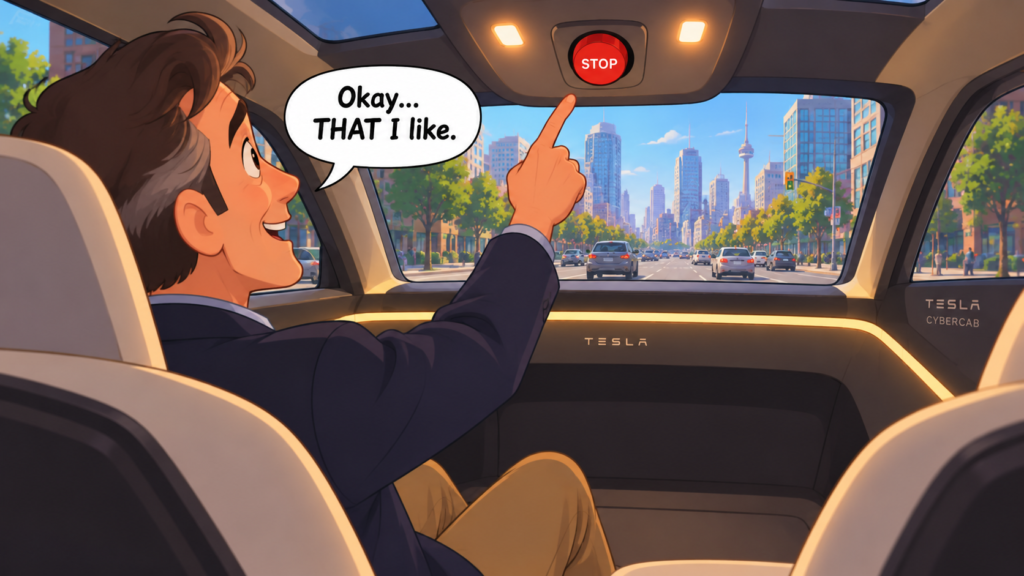
Giving customers a way OUT can make them more willing to get IN.
Tesla‘s new Cybercab has a physical Stop button mounted between the dome lights.
Press it and the vehicle requests an immediate pull-over and ends the ride.
Passengers can already request a stop through the car’s touchscreen or their app. Tesla gave ‘em a big red button anyway.
That decision says a lot about how people experience control.
Imagine you’re alone in a Cybercab when something makes you uncomfortable.
Like maybe the vehicle is behaving weirdly. Or you’re feeling sick.
Suppose you simply have to get the heck out, for some reason you’d never thought of.
In that moment, you don’t wanna be scrambling find the right menu.
You want a button to hit.
A big part of product design is figuring out how much control we’re asking customers to surrender. Automation increasingly asks us to surrender a lot.
But the principle applies to products that are far less futuristic.
It’s why software has Undo.
The reason an automatic garage door has that manual release cord.
It’s why a ski lift or escalator has an emergency stop button.
And even why good subscription services make cancellation straightforward.
And increasingly, why AI systems capable of acting on our behalf need a clear way to tell them: STOP.
Most of those controls spend nearly all their lives unused.
Their value begins long before anyone ever needs them.
An escape hatch reduces the perceived consequences of handing over control.
That can be especially important with innovative products. In I Need That, I write about the barriers that prevent people from adopting unfamiliar solutions. Innovators naturally concentrate on everything their product enables customers to do.
It’s equally useful to ask what happens when your customer wants it to stop.
Can they reverse the decision?
Can they cancel a mistaken action?
Can they override an automation that’s doing the wrong thing?
Can they get the F out?
The answer, whatever it is, will influence whether they’re comfortable jumping in.
Tesla’s Stop button is far from radical or impressive tech. Compared with an autonomous vehicle in general, it’s about as basic as engineering gets.
Yet it could be one of the Cybercab’s most important controls for mass adoption.
The thing that gives customers enough confidence to say “Go” is knowing they can always say “STOP.”
If you’d like help creating and marketing products people feel compelled to buy, the product marketing consultants at Graphos Product can help.