
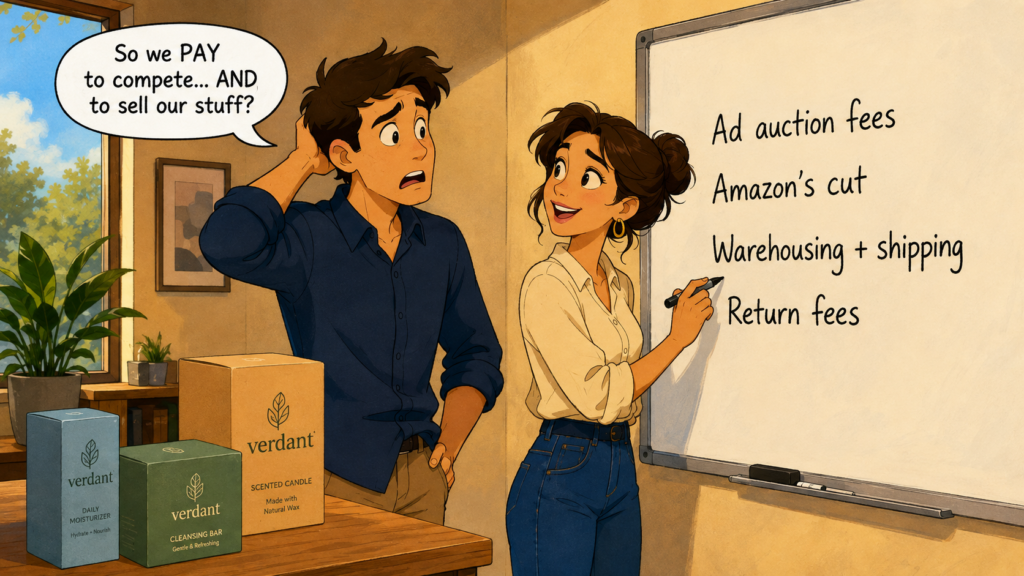
Amazon makes shopping absurdly easy. A new FTC lawsuit asks whether it made competing for visibility unnecessarily expensive.
My household is a power-user of Amazon.
We love local businesses and shop close to home whenever it makes sense.
But if the same mouthwash is a dollar cheaper delivered to my door than it is at the store across town, that choice doesn’t require a ton of thought.
And Amazon has made the whole experience ridiculously good.
Search. Click. And it… appears!
Don’t like it? Returns are often easier than lacin’ up your shoes and drivin‘ back to a store.
BUT I also work with the companies making the products Amazon sells.
Their view of this magnificent machine is pretty… different.
Amazon has become such an important product-discovery engine that many sellers pay to advertise simply to remain visible among competitors selling similar things.
Those advertisers generated $68.6 billion for Amazon in 2025 alone. Advertising revenue grew another 26% year-over-year in Q2 2026.
Now the FTC and 22 US states are alleging that Amazon secretly made those auctions even more lucrative for itself.
The lawsuit says Amazon told advertisers it operated a second-price auction, where the winning advertiser essentially pays what was necessary to beat the runner-up.
According to the FTC, Amazon began adding an undisclosed internal surcharge in 2019.
The complaint alleges this eventually caused Sponsored Products advertisers to pay their own maximum bid roughly 80% of the time, extracting tens of billions of additional dollars from more than a million brands and sellers.
Those are allegations, and Amazon disputes them. The courts can sort out who’s right.
What interests me is the marketplace dynamic underneath it all.
Amazon created new value for consumers partly by assembling an extraordinary number of competing products in one place.
Then it created another marketplace inside the marketplace, where those same product makers compete with each other for our attention, where the one who gives Amazon the most money wins.
You develop and produce the product.
You pay Amazon to sell it.
THEN you can pay again so shoppers see it.
And every competitor bidding for the same visibility makes that attention more and more valuable to Amazon.
One of the ideas I explore in I Need That is that creating something customers genuinely need is only part of commercialization. You ALSO need an economically viable route to those customers.
Marketplaces can provide mind-blowing reach.
But when the marketplace also controls the shelf, the search results, the advertising auction and the transaction, product makers need to understand whose economics are getting optimized.
Amazon makes buying mouthwash painless for me.
But what about the company fighting to put its mouthwash in front of me?
There’s a lot more action behind that Buy Now button than you and I see.
If you’d like help creating and marketing products people feel compelled to buy, the product marketing consultants at Graphos Product can help.