
Our increasingly connected lives are creating a new category of products designed to help us disconnect.
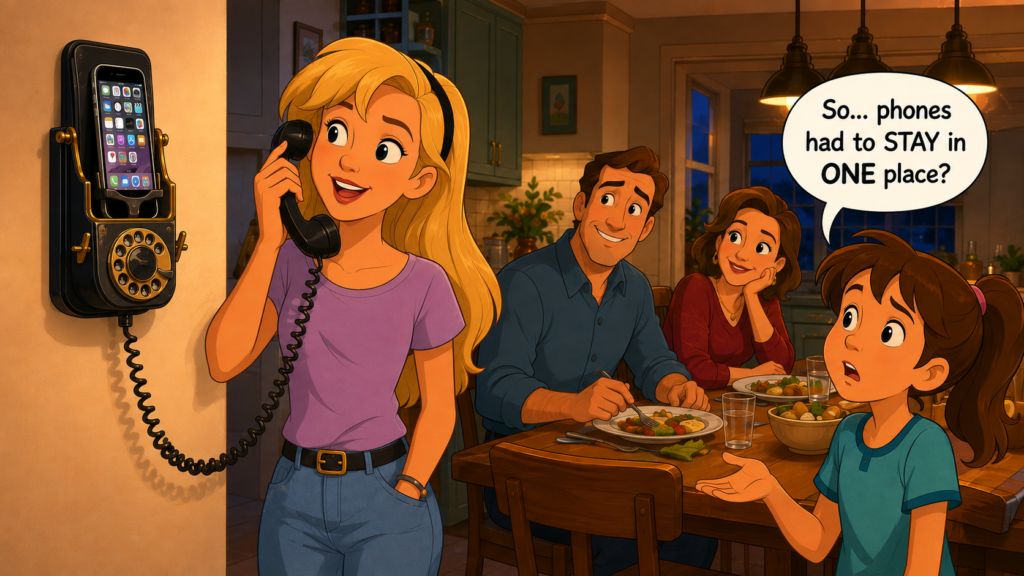
I grew up when a phone was attached to the wall. That was the only kind.
If someone called while you were having dinner, you stood at the phone. If the cord was long enough, you might pull it around a corner for some privacy.
Then humans spent decades improving the phone.
We made it cordless, mobile, connected it to the internet, added cameras, GPS, email, games, social media and pretty much everything else we could think of.
Now entrepreneurs are selling devices that turn smartphones back into wall phones.
And there’s a surprisingly good reason for that.
Research by Edith Cowan University‘s Dr. Jess Hardley examines how people are deliberately creating physical distance from their smartphones.
Participants described leaving phones in other rooms, locking them in drawers and otherwise making the devices harder to reach.
Hardley also points to phone-free events, grayscale screens, app restrictions, locking pouches and retro phone accessories as manifestations of the same desire.
There’s an interesting product lesson buried in all of this.
Every major technology creates secondary needs around the problems it introduces.
The automobile gave us stuff like parking meters, car seats, drive-throughs, gas stations and car washes.
Television brought on remote controls, reclining sofas and TV Dinners.
The internet led to spam filters, password managers, antivirus tools, Zoom calls and VPNs.
And now the smartphone has become so useful that we’re creating products to make it less useful.
Dumbphones are having a huge moment, particularly among younger users. Some preserve essentials such as calling, messaging, maps and Uber while deliberately eliminating the apps and feeds that keep sucking us back in.
Then there are products that let you keep your smartphone while changing your relationship with it.
A wall-mounted dock is fascinating because it introduces friction by design.
Your phone still works. You can still answer calls, check something important or take it with you when you leave.
But while you’re home, it has a place.
You have to get up and walk over to it, like old times.
For 30 years, product designers have been trained to remove friction. Fewer clicks. Faster access. Everything available everywhere.
Yet when excessive access is the problem, friction becomes a desired feature.
One of the ideas I explore in I Need That is that valuable product opportunities begin with understanding what people are trying to accomplish in their lives. New technology constantly changes those needs, including creating entirely new ones nobody had before.
The next big opportunity around smartphones may have nothing to do with making them smarter.
It may be helping us put the damn things down.
If you’d like help creating and marketing products people feel compelled to buy, the product marketing consultants at Graphos Product can help.