
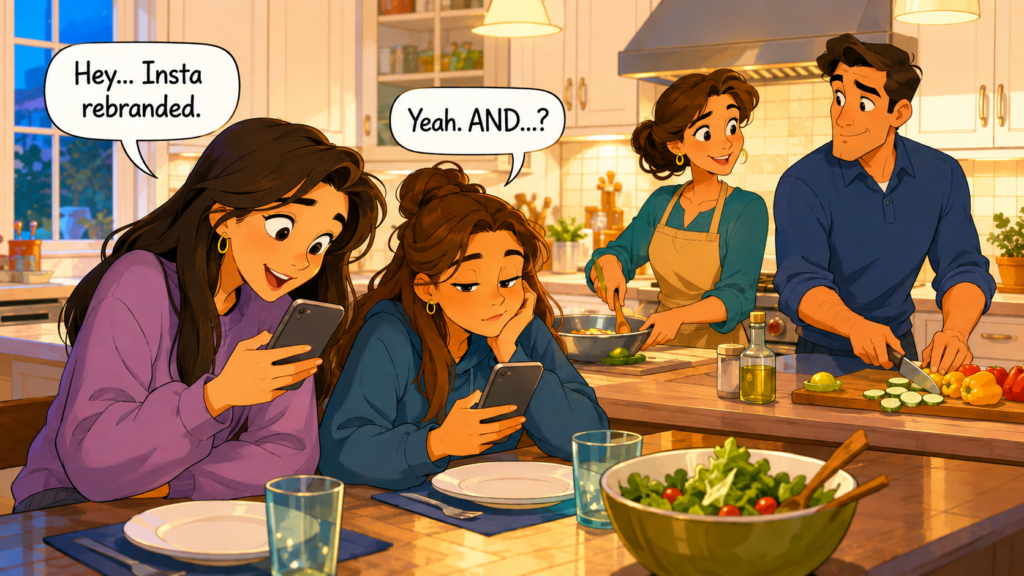
The most revealing response to a rebrand isn’t outrage. It’s indifference.
There was a time when Instagram changing its logo was front-page marketing news.
People went on about it for weeks.
Designers dissected every pixel.
Users declared the app ruined before quickly forgetting what the old logo even looked like.
But this time around… barely a ripple.
Instagram has introduced its first wordmark redesign in a decade. The app icon remains the same, but the lettering has been subtly modernized.
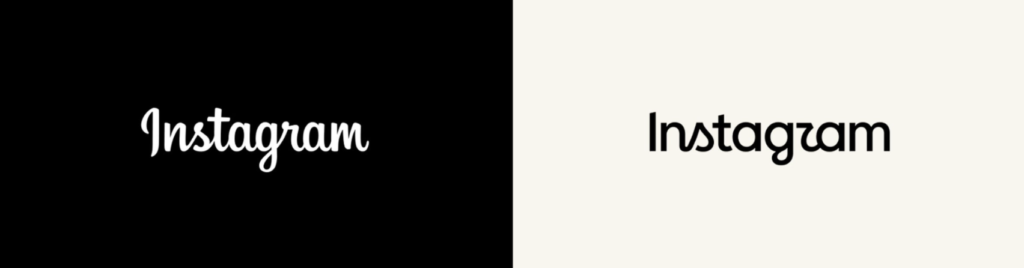
Predictably, a few folks joked it now reads “Instagzam.” (Note to Meta: kids DON’T know what a cursive “r” looks like!)
Beyond that, the reaction has been remarkably muted.
I find that kinda fascinating.
Not because the redesign is especially fantastic or heinous.
But ’cause nobody seems to care.
Contrast that with Jaguar‘s polarizing rebrand, or even Jif‘s very recent packaging refresh, where adding an apple slice and the words “Dip. Scoop. Spread.” sparked meaningful discussion about how packaging shapes buying behaviour.
Insta reaches well over a billion people.
Lots of us check it every day.
My teenage daughter certainly does. She mainly watches videos and keeps up with friends, which is how many families experience the platform today.
Yet the logo has become almost irrelevant to the conversation.
Perhaps that’s because Instagram’s visual identity is no longer its biggest brand challenge.
Meta is currently defending one of the largest cases in its history, brought by 29 U.S. states.
The lawsuit alleges the company deliberately designed Instagram and Facebook with addictive features that keep children and teens engaged, while collecting their data and downplaying known risks.
The theoretical maximum penalties discussed in court approach $1.4 trillion, although legal experts widely consider that figure unlikely to become reality.
The plaintiffs are also seeking sweeping changes to recommendation algorithms, infinite scrolling and other engagement features.
Against that backdrop, a refreshed wordmark almost looks like an attempted smokescreen, and struggles to command attention.
One of the ideas I explore in I Need That is that brands ultimately become known for the experiences they create, more than the graphics they wear.
A logo can reinforce a reputation.
It can’t fix one.
If your customers are dishing on your identity, you might have a branding problem.
If they’re talking about your behaviour instead …
Changing the logo ain’t likely to pivot the conversation.
If you’d like help creating and marketing products people feel compelled to buy, the product marketing consultants at Graphos Product can help.