
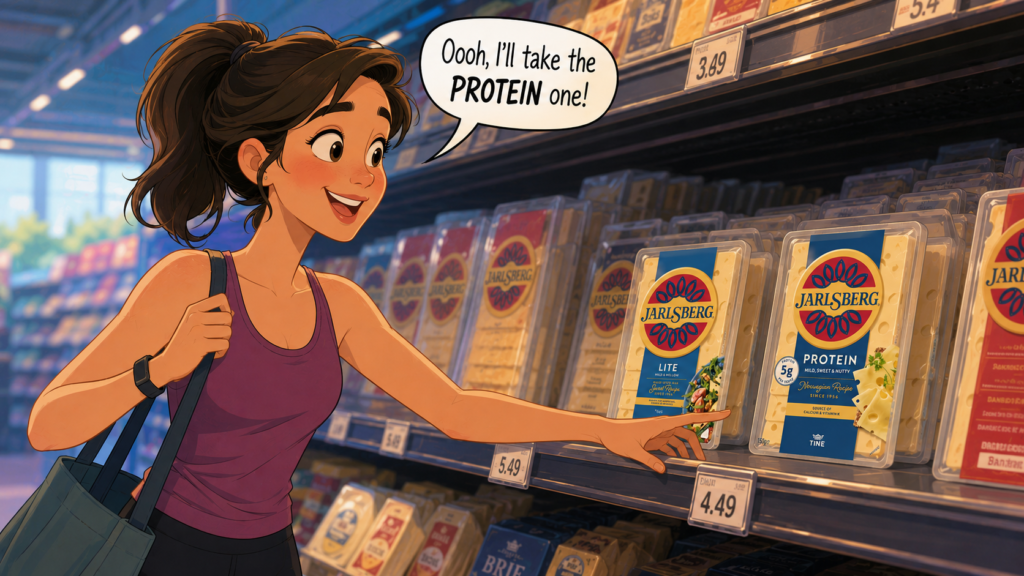
Jarlsberg’s “protein” relaunch looks sneaky to some folks, but it raises a good question: when buyer priorities change, shouldn’t your product story do the same?
A social post about Jarlsberg got me thinking yesterday.
It compares Jarlsberg Lite slices with the new Jarlsberg Protein slices and points out something sharp people noticed.
Per 100 grams, the nutrition is almost identical.
Calories: nearly the same.
Protein: same-same.
The cheese itself looks pretty much unchanged.
So what DID change?
Mainly the packaging, positioning, and serving size.
The old Lite slices were 15g each.
The new Protein slices appear to be closer to 18–20g each, which helps Jarlsberg make a much cleaner front-of-pack claim: 5g protein per serve.
A lot of people see this and immediately feel annoyed.
They think it’s sneaky. Manipulative even.
Classic marketing spin from a selfish big brand.
I understand their view.
But I think there’s a more useful (and objective) way to look at it.
Protein has become one of the strongest consumer trends in food. It’s, like, everywhere.
Yogurt, cereal, pancakes, ice cream, chips, pasta, snack bars, and even candy and soft drinks are all getting repositioned around protein.
Shoppers are actively looking for it, often using protein as a shorthand for healthier, smarter, more functional eating.
And for millions of people on GLP-1s, protein is necessary to minimize muscle loss.
That changes the whole context around how products get evaluated.
So, a cheese that used to live happily in the “lite” category can become way more relevant in the “protein” category.
Now imagine it’s your product.
You realize the market has moved in a big way. The old reason people bought your product still matters, but a new reason has exploded in importance.
Customers are seeing value through a totally different filter than two years ago.
Wouldn’t it be stupid not to respond?
I talk about several great examples of this in I Need That. Some of the most successful products in history became huge because someone stopped looking at the product through internal assumptions and started looking at it through the market’s eyes.
Viagra was originally developed to treat angina.
Bubble Wrap began as textured wallpaper.
Neither would have become famous for the job they were originally meant to do. (Although I love to imagine us all having bubble wrap on our walls.)
They succeeded because someone recognized the need folks actually cared about in that moment.
That’s often where real growth comes from.
The biggest opportunity might come from changing how the product is understood.
That’s what Jarlsberg is goin’ for here.
And I’m curious how you see it.
Smart repositioning, or protein-washing?
Would you feel different if it was a small, local brand doing the exact same thing?
Want to make your product irresistible? That’s what we do as product positioning consultants at Graphos Product, helping innovators turn need-driven ideas into market-ready successes.