
The feeling of ownership often begins way before ownership itself.
The new Ferrari Luce has gotta be the most criticized car in the world right now.
That’s impressive considering nobody has driven one.
The Luce is Ferrari’s first electric vehicle, and the internet has been fiercely debating everything from its design to its very existence.
Purists are horrified. Enthusiasts are intrigued. Everybody seems to have an opinion.
What none of these folks has is experience with the Luce.
That got me thinking about a fascinating new study on virtual reality.
Researchers found that people valued products more highly after interacting with them in VR, especially when the experience allowed them to imagine using the product themselves.
The virtual experience helped create feelings of psychological ownership, making the product feel more personally meaningful even before it was physically owned.
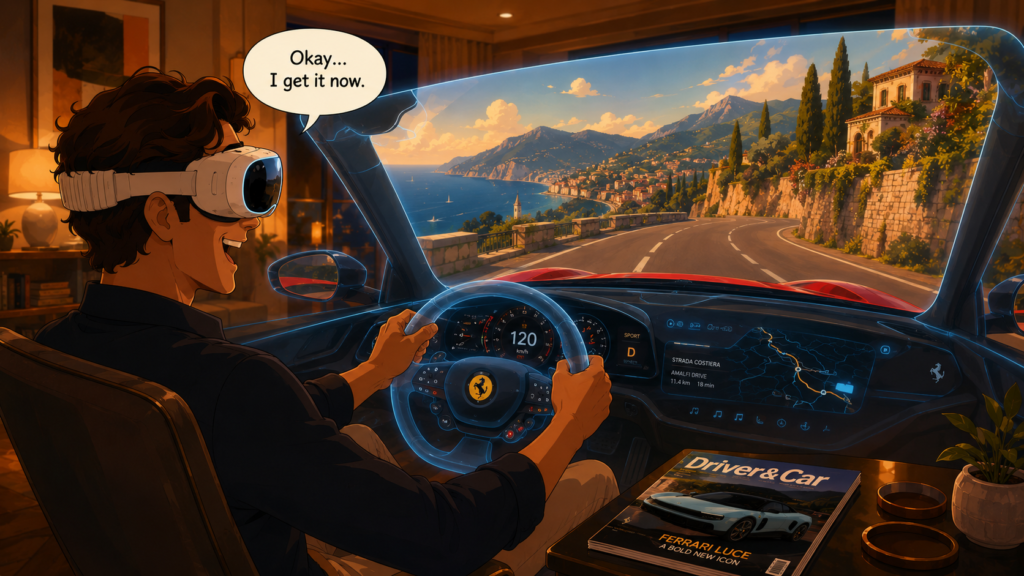
Imagine if Ferrari let critics put on a headset and take a virtual drive through the Italian countryside.
Not a video, a few photos, or a brochure.
Not some uber-slick launch presentation.
But a genuine experience where they could sit behind the wheel, hear the acceleration, look through the windshield, and imagine the car becoming part of their life.
Everything except the new-Ferrari smell.
The study suggests THAT could change how people evaluate the product.
That’s because ownership starts so much earlier than we tend to think.
Long before we hand over (usually digital) bucks, we begin mentally trying products on. We picture ourselves driving the car, wearing the watch, cooking with the appliance, or living in the house.
The stronger that mental simulation becomes, the more the product starts feeling like ours.
This isn’t limited to VR.
A Tesla test drive can do it.
Designing your own Nike shoes can do it.
Building a custom PC can do it.
Even configuring options on a vehicle website kicks in the effect.
Each pulls consumers across an invisible line from “a product” to “a product I NEED.”
The virtual reality angle is especially interesting because it may eventually allow companies to mass produce that feeling before a product even reaches the market.
In a sense, consumers could begin owning products emotionally before they can own them physically.
In I Need That, I talk about the power of imagining our future with the product as one of the most powerful forces in product marketing. Products become more compelling when people stop evaluating them as outsiders and begin seeing them as participants. That’s what fuels our fantasies like nothing else.
The Luce may one day win over its critics. Or not.
But if Ferrari ever lets them take a virtual drive first, I suspect a few minds might change.
Want to make your product irresistible? That’s what we do as product marketing consultants at Graphos Product, helping innovators turn need-driven ideas into market-ready successes.