
Your brain decides where a product ranks before you even look at it.
Over the past year, the trade war turned grocery shopping into something a little … different.
A loyalty test.
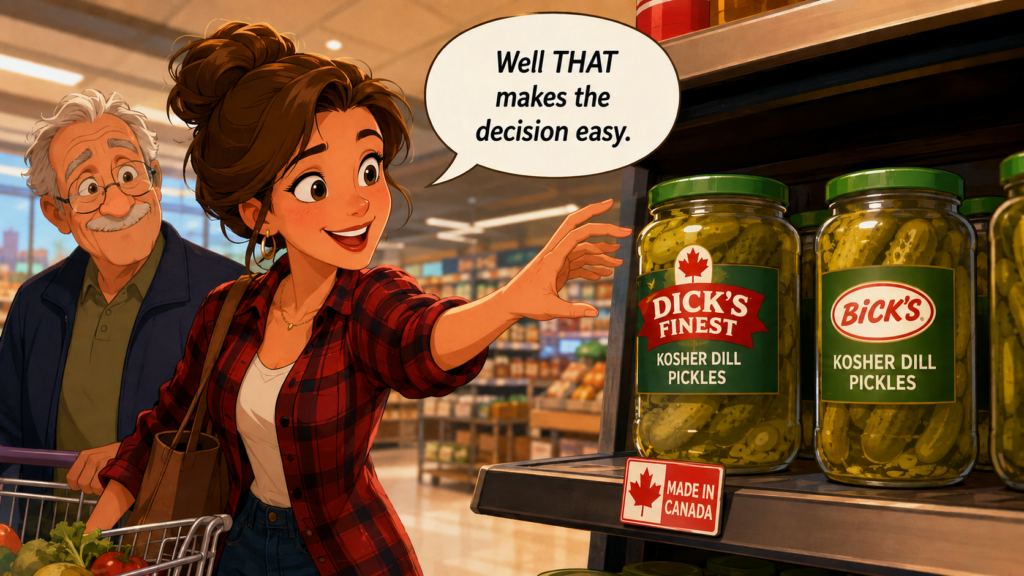
Here in Canada, Canadian flags started appearing beside products on store shelves. Consumers started scrutinizing labels for the country of origin.
Social media filled with lists of products to buy and ones to avoid, and apps emerged to help scan and filter in the aisles.
And then some oddball situations emerged.
Bick’s pickles became super controversial because the cucumbers are grown in Canada, BUT the product is packaged in the United States. Even the jar lids are made in Canada. Whose domestic product is it now?
French’s and Heinz found themselves pulled into similar conversations about ingredients, manufacturing, ownership, and where products “really” come from.
What amazed (and sometimes infuriated) me was how quickly people formed opinions.
Turns out there may be a very human reason for that.
A new study found that consumers consistently view domestic products as more environmentally friendly, safer, and higher quality than imported alternatives. Even when objective facts suggest otherwise.
The researchers call it the “our own country is best” heuristic.
In plain English, we trust things from home way more than when they come from abroad.
That trust runs pretty darned deep.
Consumers in the study consistently downgraded imported products in their minds compared to domestic ones.
Fruits and vegetables showed particularly strong effects. Products from geographically or culturally closer countries performed better than those from more distant countries.
What’s frustrating is how often this bias steers us wrong.
In one example, Spanish bell peppers can actually have a lower environmental impact than German-grown peppers because Germany often relies on heated greenhouses. Yet consumers still felt confident the domestic product was the greener choice.
That tells us something important.
Country-of-origin is doing a lot more than communicating geography.
It’s emanating trust, familiarity and social belonging: stuff that often outweighs objective analysis.
In I Need That, I talk about how products become compelling when they align with our deeply held beliefs and identities. During the trade dispute, buying Canadian stopped being a regular purchasing decision for many people.
Now it was an expression of values.
That’s why country-of-origin labels can be so powerful.
People buy stories that help them feel confident they made the right choice.
And not a lot of stories feel more reassuring than “it’s made right here.”
Want to make your product irresistible? That’s what we do as product marketing consultants at Graphos Product, helping innovators turn need-driven ideas into market-ready successes.