
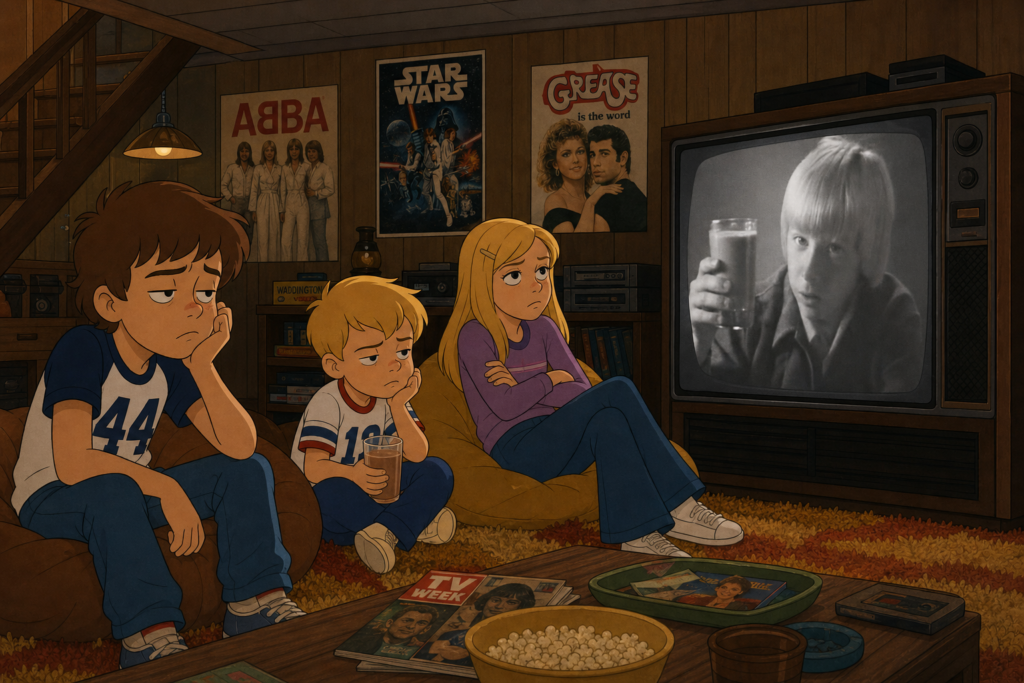
Repetition, rhythm, and annoyingness can encode messages far deeper than we expect.
Yesterday a commercial from 1979 popped into in my head.
Not a tagline or fragment, but the full script for a Milk Mate chocolate syrup ad, word for word.
I wondered if I could possibly be remembering it as well as I felt I was.
So I looked it up and watched it, saying the words just ahead of the blond-headed boy on the screen.
My memory matched, 100%.
Forty-seven years living rent-free somewhere in my head, still perfectly intact.
I was ten years old back then. It wasn’t even a great commercial, and although I liked the product (come on … chocolate syrup!), it wasn’t one I got at home.
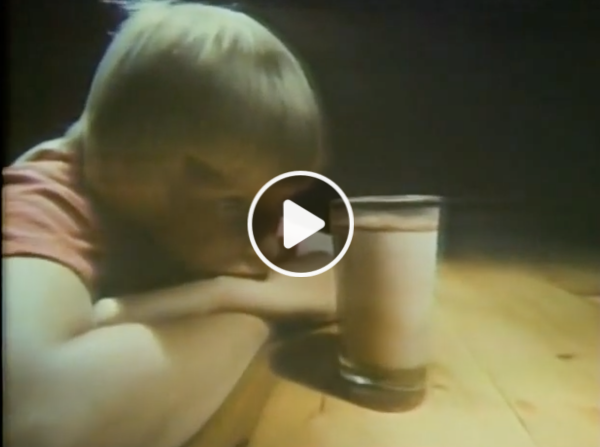
My grandmother’s pantry stocked Milk Mate syrup, but my parents bought the kind of cheap powder the young visionary in the commercial complained “floated on top, or got wasted on the bottom” of the cup.
The blond kid had felt my pain, but now lived my Coveted Condition™.
That commercial isn’t a one-off. I can recite a lame old Sunkist ad from the same era. Word for word.
And here’s the thing: I’ve NEVER been great at memorizing scripts.
In elementary school plays I was happy to be cast as the sun or a silent guard, to avoid the pain of learning a speaking part.
That’s why this is so weird at the surface, and yet it’s predictable through brain science.
Memory is maximized when three conditions line up:
Repetition builds the pathway.
Emotion (including when you annoy someone) embeds it at a neural level.
Structure makes it easy to retrieve.
Those ads had all three.
They ran frequently, often during the same programs, so the exposure was daily, for months at a time. The pain was one I personally experienced (alongside a few other rough first-world problems).
They used tight rhythm and structure, which compresses information into patterns the brain can replay easily.
Plus they arrived at a time of day and in an era when attention was focused, with much fewer competing inputs.
That part is much, much harder to replicate today.
Neuroscience research points to the role of the hippocampus in encoding episodic memory and the way repeated, structured stimuli can carve information into longer-term storage.
Musical phrasing and cadence further reinforce recall by engaging multiple neural pathways. (I do know me a LOT of annoying old jingles too.)
If I saw those 1970s scripts for the first time today, learning them would take effort. It wouldn’t stay with me for days, much less four or five decades.
Yet back in the day, it happened passively.
The product was dirt-simple; the irritating repetition did the heavy lifting.
That’s the opportunity for founders.
In any crowded environment, clarity alone struggles.
Almost no brand sticks with a campaign long enough to make it sufficiently annoying to become memorable. On many platforms, annoying gets you skipped as soon as the option appears.
Which is sad, because we all remember the most annoying commercials, while forgetting thousands of others.
Structure, timing, and repetition, repetition, repetition still shape what sticks.
What do you stop repeating just as the message begins to be remembered?
Want to make your product irresistible? That’s what we do as product marketing agency at Graphos Product, helping innovators turn need-driven ideas into lickety-split successes.