
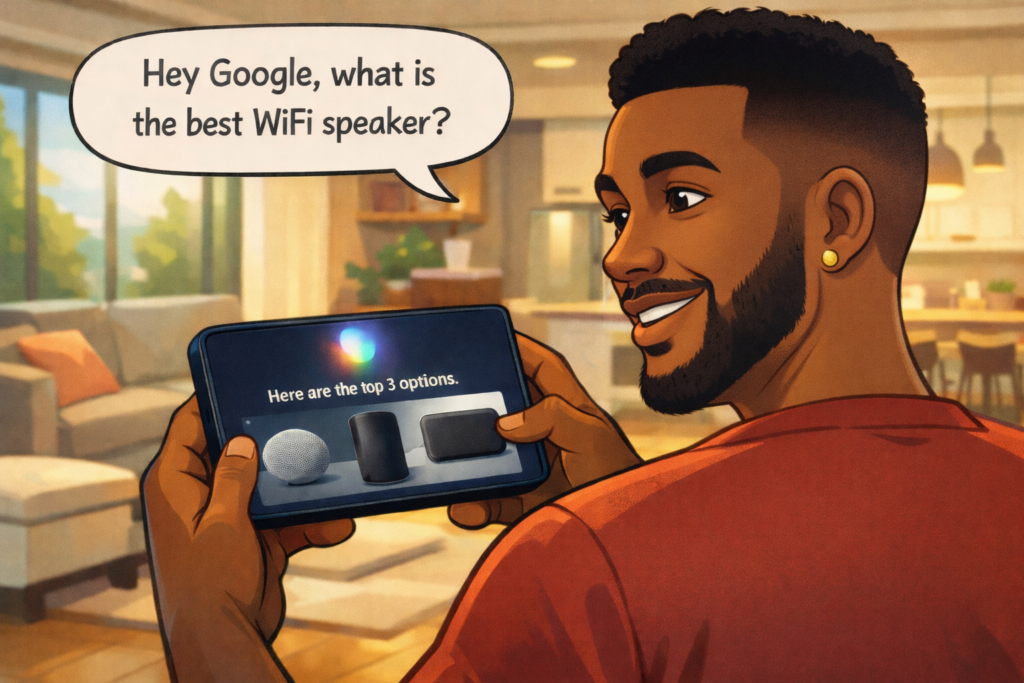
AI is changing how people learn stuff, but not necessarily how they buy.
I came across an intriguing new study by researchers at Harvard Business School and Stanford examining exactly how people are shifting between AI tools and traditional search.
The headlines and pro stars warn us AI is fast replacing search tools like Google.
Um … that’s not really what’s happening.

Drawing on a large dataset, the analysis reviewed a full year of first-party data across 973 websites representing roughly $20 billion in revenue, comparing more than 50,000 ChatGPT-driven transactions against 164 million transactions from traditional channels.
All that studyin’ shows people turning to LLMs when they want fast understanding. Explanations, summaries, and quick answers now get routed through tools that remove friction and remove brain-work.
But when the question gets specific, and money is on the line, behavior changes.
Stuff like choosing (not finding) a restaurant, comparing products, evaluating vendors, checking availability. People still move into search environments where they narrow the options, weigh tradeoffs, and it’s time to make a decision with confidence.
AI researches, search decides.
Both matter, but at different moments for different folks.
This gets more pronounced in complex B2B decisions with more details and lots at stake, or where consumers get out the credit card.
Early-stage learning increasingly happens inside AI tools, but validation and sourcing still depend on search. Buyers want to see the landscape, and not just a synthesized answer that could be full of hallucinated beans.
That creates a structural blip in discovery.
Products are no longer being found through a single channel, like we did not long ago. They are encountered across a sequence of environments, each with a different job that we’re carving out for them in real-time.
If your product is optimized for one and not the other, you can easily vanish partway through the journey.
Most teams are still thinking in channels.
Buyers, on the other hand, are moving through systems.
Perplexity, Google AI summaries, agents, marketplaces, traditional search. These aren’t replacing each other, but are splitting up the work.
And THAT changes how products get chosen.
What does your data show to be different from before? I’d love to hear from you … just hit reply.
Want to make your product irresistible? That’s what we do as product marketing consultants at Graphos Product, helping innovators turn need-driven ideas into market-ready successes.